


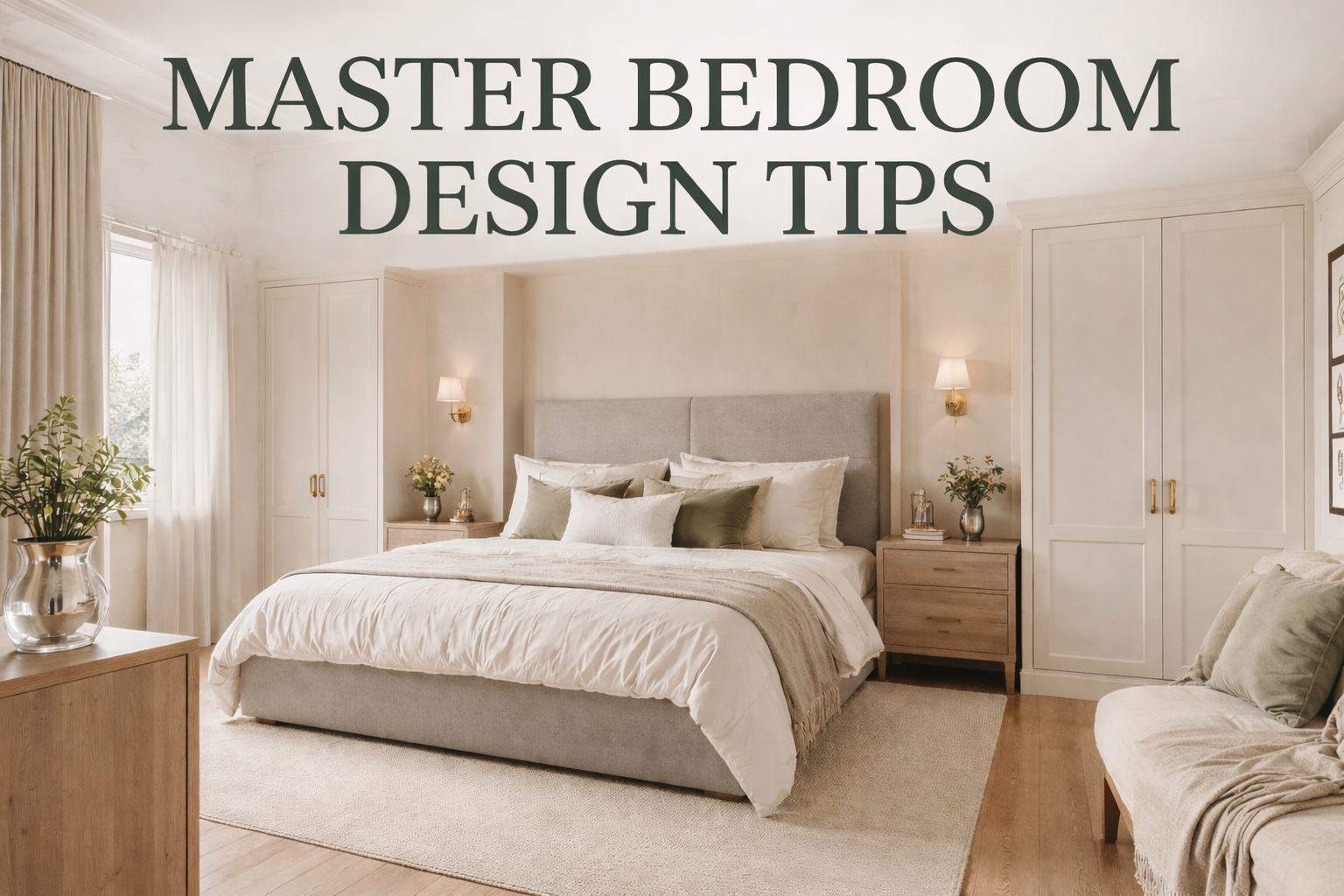
Master Bedroom Design Tips
Master Bedroom Design Tips for Homeowners

Designing a master bedroom sounds simple until you actually start making decisions. Then suddenly you are juggling layout, storage, lighting, colours, flooring, window treatments, and the eternal question of whether the room should feel cosy, luxurious, minimal, or all three at once.
For London homeowners, it gets even trickier. Bedrooms are often squeezed into Victorian terraces, converted flats, loft spaces, or narrow new-build layouts where every inch matters. So the goal is not just to make the room look good. It is to make it feel calm, work harder, and still hold its value over time.
This guide is written from the point of view of a bedroom designer: practical first, stylish second, and always realistic about how London homes actually function.
The homeowner examples below are composite examples based on common London renovation patterns, included to show how these ideas work in real life.
Why the master bedroom deserves more attention

A lot of people treat the main bedroom as the last room to finish. They focus on the kitchen, bathroom, and living room first, then end up throwing a bed, two mismatched lamps, and a freestanding wardrobe into the bedroom and calling it done.
That usually leads to a room that feels unfinished, cluttered, or oddly stressful.
A well-designed master bedroom should do a few jobs at once. It should help you sleep better, store more, feel calmer, and give the home a more polished overall finish. In a London property, where space is expensive and often awkward, that matters even more.
Start with the layout, not the shopping list
The biggest mistake homeowners make is buying furniture before working out the room properly.
Put the bed in the strongest position

In most bedrooms, the bed should sit on the main uninterrupted wall. That gives the room a focal point and usually creates the best visual balance as soon as you walk in. If possible, keep access on both sides of the bed. Even in a tighter room, a little symmetry goes a long way.
If the bed is shoved into a corner, jammed under a window, or blocking wardrobe doors, the whole room starts feeling compromised.
Think in zones
Even a modest master bedroom works better when it is designed in zones. Usually that means:
- a sleep zone around the bed
- a dressing or storage zone
- a small secondary function like a reading chair, vanity area, or bench
That does not mean the room needs to be big. It just means each piece of furniture should have a reason to be there.
Leave breathing room
A bedroom feels luxurious when you can move around it easily. You do not need a huge footprint, but you do need sensible circulation space. If opening the wardrobe means hitting the bedside table, or walking around the bed feels like squeezing through a hallway, the layout needs another look.
Storage is where great bedroom design really begins

If you asked me what makes the biggest difference in a London master bedroom, I would not say paint colour. I would say storage.
Fitted wardrobes usually win
Freestanding wardrobes can work, but fitted wardrobes almost always make better use of space, especially in London homes with alcoves, sloped ceilings, chimney breasts, or uneven walls.
They use full ceiling height, reduce dead space, and make the room feel tailored rather than temporary. Current UK cost guides show just how wide the range can be: a three-door fitted wardrobe can run from around £1,500 to £7,000, while a four-door version can be around £3,900 to £10,000, depending on finish, internals, and how bespoke the design is.
Hidden storage makes a room feel calmer
The most successful bedrooms do not necessarily have less stuff. They simply hide it better.
Ottoman beds, fitted wardrobes with internal drawers, slimline bedside storage, overhead cupboards above doorways, and built-in dressing tables can transform how a room feels day to day. Once clutter is tucked away, even a small bedroom starts to feel more expensive.
Composite homeowner example
A couple in a Victorian terrace in Walthamstow replaced a bulky dark wardrobe and chest of drawers with pale fitted joinery across one wall. They did not gain extra floor area, but the room looked wider, brighter, and far more intentional. When they later spoke to an estate agent, the built-in storage was one of the first things mentioned because it solved a common pain point for buyers in similar houses.
Use colour to soften light

London light is different from the bright, sharp daylight you see in a lot of inspiration photos online. Many bedrooms here have cooler natural light, overlooked windows, or grey skies for a good part of the year. That is why soft, warm tones tend to work so well.
Colours that usually work beautifully
Warm neutrals, soft taupe, greige, muted sage, dusty blue, mushroom, and gentle clay tones are all strong choices for a master bedroom. They feel calm without being boring and they tend to work across both period and modern homes. Bright white can sometimes feel flat or clinical, especially in a north-facing room. A warmer off-white usually feels more restful.
Dark colours can work too
Dark bedrooms can look amazing, but they need balance. If you love deep olive, charcoal, navy, or chocolate tones, use them with texture and layered lighting. Upholstered headboards, warm bulbs, wood tones, and soft fabrics stop the room from feeling heavy. The trick is not to copy a trend blindly. It is to ask whether the room has enough light and enough space to carry it.
Lighting is what turns a basic bedroom into a beautiful one
One central ceiling fitting is almost never enough.
Layer the lighting
A good master bedroom usually needs three kinds of light:
ambient lighting for the whole room, task lighting for reading or dressing, and softer accent lighting for mood. That could mean a ceiling pendant or discreet downlights, bedside wall lights, a wardrobe light strip, and maybe a small lamp near a chair or dressing table. Supply and installation costs for downlights are commonly estimated at around £300 to £500 per project, while recessed lights often average roughly £40 to £80 per light, depending on spec and access.
Wall lights save space
In smaller London bedrooms, bedside wall lights are often a smarter choice than table lamps. They free up the nightstands, feel more hotel-like, and make the bed wall feel finished.
Composite homeowner example
In a loft bedroom in Clapham, the owners kept complaining that the room felt “a bit cheap” even after repainting. The issue was not the furniture. It was the lighting. Once they swapped the single central light for dimmable bedside wall lights, wardrobe LEDs, and a softer ceiling fitting, the room suddenly felt warmer and far more expensive.
Flooring and fabrics matter more than people think

Bedrooms are tactile spaces. You notice them with your feet, your hands, and your eyes.
Choose flooring for comfort as well as style
Carpet is still one of the best choices if you want warmth and quieter acoustics. Engineered wood gives a more premium, hotel-style look. Laminate can work well if you want a cleaner finish on a tighter budget.
Current UK guides put general flooring supply-and-fit costs at roughly £25 to £80 per square metre, while laminate itself often starts from around £5 to £30 per square metre before fitting, depending on quality.
Soften the room with fabric
If your bedroom feels cold or unfinished, the answer is often not more furniture. It is better fabric choices.
Full-length curtains, blackout linings, layered bedding, a large rug under the bed, and an upholstered headboard all add softness and comfort. They also help visually quiet the room.
Blackout blinds themselves can range widely by type and size, and fitting blinds in the UK commonly runs around £20 to £30 per blind, with average blind supply costs often falling around £30 to £127. Curtain or blind fitting guides also put basic installation costs in the same general range.
Make the bed wall do the heavy lifting
If there is one place to spend design energy, it is the wall behind the bed.
Create a proper focal point
An upholstered headboard, a painted feature wall, simple wall panelling, or matching bedside wall lights can make the entire room feel considered. You do not need anything flashy. You just need one clear focal point.
Symmetry works hard
Even if the room is not perfectly symmetrical, creating some balance around the bed makes the room feel more restful. Matching bedside tables, similar lighting on both sides, or evenly placed artwork all help.
This is especially useful in London homes where room proportions are often less than ideal. A bit of visual order can make a strange room feel much more settled.
Design differently depending on the property type
Not every London bedroom should be designed the same way.
Victorian and Edwardian homes
These often come with chimney breasts, alcoves, higher ceilings, and odd gaps that are perfect for bespoke joinery. Instead of fighting those quirks, use them. Built-in wardrobes either side of a chimney breast can look brilliant and make the room feel original to the house.
New-build flats
These bedrooms are often boxier and more compact. Here, the goal is softness. Use texture, layered lighting, and warm tones so the room does not feel too flat or clinical.
Loft bedrooms
Loft master bedrooms can be beautiful, but sloped ceilings need smarter planning. Keep low-level storage under the eaves, use light colours, and avoid heavy furniture that makes the room feel chopped up.
How bedroom design can add value to your home
A bedroom redesign rarely adds value in the same dramatic way as a new kitchen extension, but it can absolutely improve buyer appeal and day-to-day usability.
Well-planned home improvements and stronger presentation are commonly cited as value-adding factors, although the exact uplift depends heavily on the property, the area, and the ceiling price for the street.
The upgrades that usually help most
The best value-adding bedroom upgrades are the ones that solve practical problems:
better storage, stronger lighting, better flooring, improved window treatments, and an overall finish that makes the room feel move-in ready.
If the room is cold or draughty, energy-efficiency improvements can help too. GOV.UK recommends measures such as insulation and draught-proofing to make homes cheaper to heat and more comfortable.
Composite homeowner example
A homeowner in South London refreshed their main bedroom before putting the property on the market. They did not move walls or add square footage. They simply repainted in a warmer neutral, replaced the old carpet, added fitted wardrobes, and upgraded the lighting. The feedback from viewings was noticeably stronger because the room felt bigger, calmer, and easier to imagine living in. That is often how bedroom design adds value in real life: not always through a dramatic number, but through better presentation and better function.
What a master bedroom makeover might cost
As a rough guide, current UK benchmarks show that decorating and furnishing costs vary widely depending on room size, finish level, and how much bespoke work is involved. Painting a small bedroom commonly falls around £250 to £400, larger bedrooms around £350 to £660, fitted wardrobes vary widely, flooring supply and fit can be £25 to £80 per m², and electricians’ day rates commonly sit in the £320 to £480 range, with location affecting cost.
| Upgrade item | Average price guide | What that usually means |
|---|---|---|
| Repainting a small bedroom | £250–£400 | A straightforward refresh with standard prep. |
| Repainting a large bedroom | £350–£660 | More wall area, more labour, and often more prep. |
| Fitted wardrobe, 3-door | £1,500–£7,000 | Huge range depending on bespoke design and internal fittings. |
| Fitted wardrobe, 4-door | £3,900–£10,000 | Better for full-width storage walls. |
| Downlights project | £300–£500 | Typical supply-and-install benchmark for a modest room. |
| Recessed light, per light | £40–£80 | Useful for estimating more detailed lighting plans. |
| Flooring supply and installation | £25–£80 per m² | Depends on material and fitting complexity. |
| Laminate flooring material | £5–£30 per m² | Material only, before labour and extras. |
| Blind fitting | £20–£30 per blind | Supply is usually extra. |
| Blind supply | £30–£127 per blind | Depends on type, size, and finish. |
In London, quotes can easily climb above national benchmarks because labour rates, access, parking, and finish level all affect the total cost. Tradesperson day rates in UK guides also note that location is one of the reasons prices vary.
Pros and cons of redesigning a master bedroom
Pros
A well-designed master bedroom can improve sleep, reduce clutter, make daily routines easier, and make the whole home feel more finished. It can also make the property more appealing to future buyers, especially when storage has been thoughtfully added.
Cons
The downside is that bedroom projects can become surprisingly expensive once bespoke storage, new flooring, upgraded lighting, and window treatments are added together. It is also easy to overspend on trend-led choices that may not age well.
The smartest approach is usually to get the fundamentals right first: layout, storage, lighting, and comfort.
FAQ
What is the best colour for a master bedroom?
Usually a warm neutral, soft green, muted blue, or taupe. The best choice depends on how much natural light the room gets.
Are fitted wardrobes worth it?
In most London homes, yes. They make much better use of awkward space and usually help the room feel less cluttered.
Is carpet or wood better in a master bedroom?
Carpet is warmer and quieter. Wood or laminate gives a cleaner, more hotel-style look. It depends on the feel you want.
What is the first thing to upgrade in a tired bedroom?
Start with layout and storage. After that, lighting usually gives the biggest visual improvement.
Can a master bedroom redesign add value?
It can improve buyer appeal and usability, especially when it adds storage, improves presentation, and makes the room feel more finished. Exact value uplift depends on the home and local market.
Do blackout curtains or blinds really make a difference?
Yes. They help with sleep quality, privacy, and comfort, especially in city homes with street lighting or early morning light.
Final thoughts
The best master bedroom design is not the one with the most expensive furniture or the boldest Instagram look. It is the one that feels restful, works properly, and suits the way you actually live.