


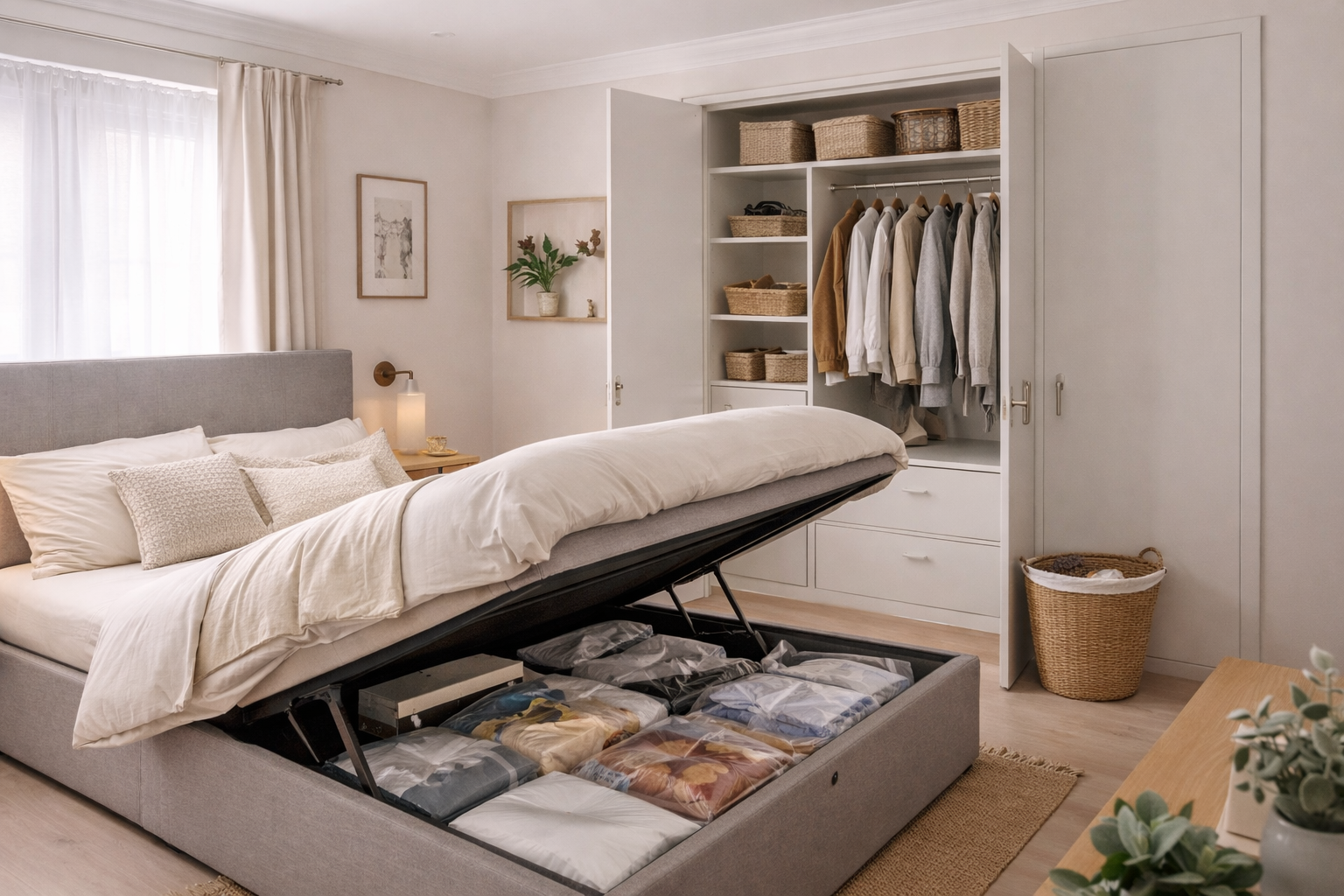
Small Bedroom Organization
Small Bedroom Organization (London Edition): a calm, clutter-free room that actually stays tidy

Small bedrooms are basically a London rite of passage—box rooms, chimney-breast alcoves, odd corners, and wardrobes that feel like they were designed for one coat and a prayer.
The good news: you don’t need a bigger room. You need a better system—one that protects your walkways, hides the visual noise, and makes getting dressed (and going to bed) feel easy.
Below is how I’d tackle this as a bedroom designer, written for real London life (busy mornings, limited storage, and a bedroom that sometimes has to do double duty).
Quick-start: pick your time budget
30 minutes (instant relief)
- Clear all visible surfaces (bedside tables, window sill, chair-dump zone).
- Put a laundry bag/basket where clothes actually land.
- Create a tiny “landing tray” for keys, watch, lip balm, chargers.
2 hours (big visual upgrade)
- Reorganise one area fully: wardrobe OR under-bed OR chest of drawers.
- Add dividers to drawers (underwear/socks/chargers). These are cheap but powerful.
One weekend (the full glow-up)
- Re-zone the room (sleep + dressing + optional work/vanity).
- Upgrade storage where it matters most: under-bed + wardrobe interior.
The 6 rules I use in every small bedroom

- Walkways first. If you can’t open the wardrobe or walk to the bed without shimmying sideways, nothing else will feel good.
- Closed storage = calm. Open shelves look “styled” for about 48 hours… then they turn into display clutter.
- Go vertical before you go wide. Walls and doors can store loads without eating floor space.
- Every item needs a “home.” Not a “place for now.” A home.
- Make it easy to reset. If tidying takes longer than 5 minutes, it won’t happen consistently.
- Your habits matter more than aesthetics. The best system is the one you’ll actually use at 11pm.
Step 1: Declutter in a way that helps property value too
This isn’t about becoming a minimalist. It’s about making the room feel bigger and more “expensive” by reducing visual noise.
The “75% rule” for wardrobes (especially if you might sell in future)
Home-staging guidance often recommends keeping built-in storage only about 75% full, because buyers open wardrobes and cupboards and judge storage capacity based on how spacious it feels. (Prep’n Sell)
Even if you’re not selling: this is still a brilliant rule. It makes your wardrobe easier to use and stops it turning into a crushed, chaotic mess.
A quick London-friendly wardrobe edit
- Out-of-season out of sight: heavy coats, thick duvets, ski gear (vacuum bags + under-bed is perfect).
- One-in, one-out for hangers: if you add a new coat, donate/sell an old one.
- Keep only daily items at “arm’s reach” height—higher shelves are for seasonal or occasional items.
Step 2: Zone the room (this is where small bedrooms win)
A small room feels bigger when it has clear “jobs.”
Sleep zone
- Bed + bedside essentials only (lamp, book, charger, water).
- Anything else becomes visual stress.
Dressing zone
- Wardrobe + mirror + laundry solution.
- If your mirror is currently “somewhere random,” anchoring it near the wardrobe makes mornings smoother.
Optional: micro desk / vanity zone
- If you need one, go for wall-mounted or fold-down.
- Don’t let it bleed into the sleep zone (sleep needs mental calm).
Step 3: Storage upgrades that actually work in bedrooms

The bed: your biggest hidden storage opportunity
Ottoman beds (my #1 space-saving upgrade)

Ottoman beds are basically “a wardrobe under your mattress.” Retailers commonly price them from around £199 up to just under £1,700, depending on size and features. (happybeds.co.uk)
If you want a second benchmark: some mainstream UK bed bundles start from around the £198 mark. (dreams.co.uk)
Best for: bedding, seasonal clothing, spare towels, suitcases.
Real-life tip: don’t store daily-use items in the ottoman. You’ll hate lifting it constantly. Store “weekly/monthly” stuff.
Under-bed drawers (good, but only in the right scenario)
These are great if:
- you’ll access items often, and
- you have enough clearance and layout space to pull drawers out easily.
Wardrobes: make the inside smarter before buying anything

Here’s the order I follow:
- Double hanging (if you can)
Split one section into top + bottom rails for shirts, jackets, skirts. - Add drawers or drawer inserts
If your wardrobe is mostly shelves, clothing piles get messy fast. Drawers keep categories separate. - Hooks inside doors
Belts, bags, tomorrow’s outfit, scarves—stuff that otherwise ends up on “the chair.”
How much do fitted wardrobes cost in the UK/London market?
Costs vary wildly with size, spec, and whether you’re going fully bespoke—but here are reliable benchmarks:
- Checkatrade notes an average £3,400 price for a 2-section custom-built fitted wardrobe (2026 figure). (Checkatrade)
- Another guide estimates £530–£770 per linear metre for a “good” fitted wardrobe, depending on internal options. (Online Bedrooms)
- Which? references pricing based on surveys of trusted traders and retailers (Nov 2025 survey, published Jan 2026). (Which?)
Designer note: fitted wardrobes can be incredible in London bedrooms with alcoves, sloped ceilings, or weird corners—because they reclaim space you can’t use with freestanding furniture.
Alcoves & chimney breasts: the “London special”
If you have alcoves either side of a chimney breast, you’ve got a huge opportunity:
- Lower cupboards hide bulky “life stuff” (extra bedding, tech boxes, hair tools).
- Upper shelves for books and curated decor (keep it minimal so it feels calm).
Best combo for small rooms: cupboards below, one shelf above, and leave some breathing space.
Walls & doors: free storage with zero floor footprint

- Over-door hooks for robes and bags
- High-level shelves above door or wardrobe for suitcases and seasonal bins
- Wall-mounted bedside tables to keep the floor visually open (rooms feel bigger when you see more floor)
A wardrobe interior blueprint (easy mode)
Hanging
- Everyday: front and centre
- Occasion wear: one section
- Long items: one dedicated area (don’t block other sections)
Shelves
- Stack by category (tees, knits, jeans), not by “whatever fits”
- Use fabric bins to stop piles slumping
Drawers
- Dividers for underwear/socks/cables
- One “messy drawer” is allowed, but only one
Lighting
A dark wardrobe feels smaller. Simple stick-on or battery lighting makes it easier to keep tidy.
What it costs: realistic budget ranges (London homeowners)
Here are typical price bands to help you plan. (It’s not a quote—just good market benchmarks.)
| Upgrade / service | Typical cost range | Notes / sources |
|---|---|---|
| Professional organiser / declutterer | ~£35–£65+ per hour | London hourly range cited by a professional organiser. (ALifeMoreOrganised) |
| Decluttering consult/report (optional) | ~£40–£85 for 1 hour; ~£60–£150 for 2 hours | Typical ranges reported by a UK interiors publisher. (Ideal Home) |
| Ottoman bed | ~£199 to ~£1,700 | Wide range depending on size/features. (happybeds.co.uk) |
| Fitted wardrobe (2-section benchmark) | ~£3,400 average (example benchmark) | Cost guide benchmark (2026). (Checkatrade) |
| Fitted wardrobe (per linear metre) | ~£530–£770 per metre | Useful for estimating longer runs. (Online Bedrooms) |
Will organizing a small bedroom add property value?
Straight answer: organisation alone doesn’t “add value” like an extension does, but it can absolutely help you:
- present the home better,
- make rooms feel larger,
- and remove buyer objections (“there’s no storage in this flat”).
Staging advice consistently points to storage being scrutinised (people open wardrobes/cupboards), and recommends keeping storage looking spacious—around that 75% full mark. (Prep’n Sell)
A few “customer experiences” (composite examples from common London projects)
These are illustrative composites (not literal testimonials), but they mirror what I see all the time:
- The Clapham flat with the “chair pile” problem:
The owners swapped a bulky bedside unit for a wall-mounted one, moved laundry into a lidded basket, and used under-bed storage for spare bedding. Result: the room felt calmer and larger in photos, and their estate agent feedback focused on “great storage” instead of “small bedroom.” (No guaranteed £ uplift—but noticeably stronger viewing comments.) - The Walthamstow Victorian terrace with alcoves:
They added simple alcove cupboards (not full bespoke joinery—just clean doors and one shelf above). Result: the bedroom stopped being a dumping ground, and it looked “finished,” which helped the whole home feel more premium during viewings. - The Canary Wharf rental bedroom refresh:
They didn’t change furniture—just reorganised the wardrobe using zones + dividers, and kept storage under that “looks roomy” level. Result: mornings became easier and the room stayed tidy in 5 minutes a day.
If you want, tell me your bedroom type (box room / alcoves / loft / new build) and I’ll suggest the best “value-for-money” upgrade path for your layout.
Pros and cons: the honest cheat sheet
Ottoman bed
- Pros: huge hidden storage; perfect for bedding/seasonal items. (happybeds.co.uk)
- Cons: not ideal for daily-access items; can become a junk pit if you don’t label categories.
Fitted wardrobes
- Pros: best use of awkward corners; clean look; can dramatically improve usability. (Checkatrade)
- Cons: cost; lead time; less flexible if your needs change.
Open shelving
- Pros: cheaper; airy; nice for curated items.
- Cons: dust + visual clutter risk (small rooms can feel “busy” fast).
Hiring a professional organiser
- Pros: faster decisions, better systems, less overwhelm; London rates often £35–£65+ per hour. (ALifeMoreOrganised)
- Cons: cost; you still have to make the decisions (they can’t do it for you).
How to keep it organized (without becoming a full-time tidying person)
The 5-minute nightly reset
- Clothes either hung, in laundry, or folded.
- Clear bedside surface.
- Put tomorrow’s outfit in one place (hook/door/one chair only).
The weekly 15-minute refresh
- Re-fold one drawer
- Return items to zones
- Empty the “landing tray” if it’s overflowing
The seasonal 45-minute swap
- Rotate coats/duvets
- Donate/sell 5 items
- Re-label storage (future you will thank you)
FAQ (London homeowners ask this all the time)
Do I need fitted wardrobes in a small bedroom?
Not always. If your room has awkward angles, alcoves, or wasted corners, fitted can be worth it. But if the room is fairly square, you can get 80% of the benefit by improving wardrobe internals and adding under-bed storage first. (Budget smarter, then upgrade later.) (Checkatrade)
What’s the fastest way to make a small bedroom feel bigger?
Clear surfaces, keep furniture visually lighter (wall-mounted where possible), and reduce wardrobe clutter so storage looks spacious—aim for that 75% full feel. (Prep’n Sell)
Are professional organisers worth it?
If you’re overwhelmed or short on time, they can be brilliant—especially for creating systems that stay organised. London hourly rates are often in the £35–£65+ range. (ALifeMoreOrganised)
How do I organize a box room without it feeling cramped?
Use closed storage, protect the walkway, and keep the sleep zone clean. Treat it like a hotel room: everything has a hidden home.
Can bedroom organization help with resale?
It can improve presentation and reduce buyer objections—especially around storage. It’s not a guaranteed £ uplift, but it can support stronger viewing feedback and help the home feel “easy to live in.” The key is spacious-looking storage and clutter-free surfaces. (Prep’n Sell)

Comment (1)
[…] layout and better storage decisions. In this guide, I’ll walk you through 10 genuinely useful small bedroom organization ideas (not just Pinterest-pretty ones), with realistic UK/London price guidance, pros and cons, and […]
Comments are closed.