


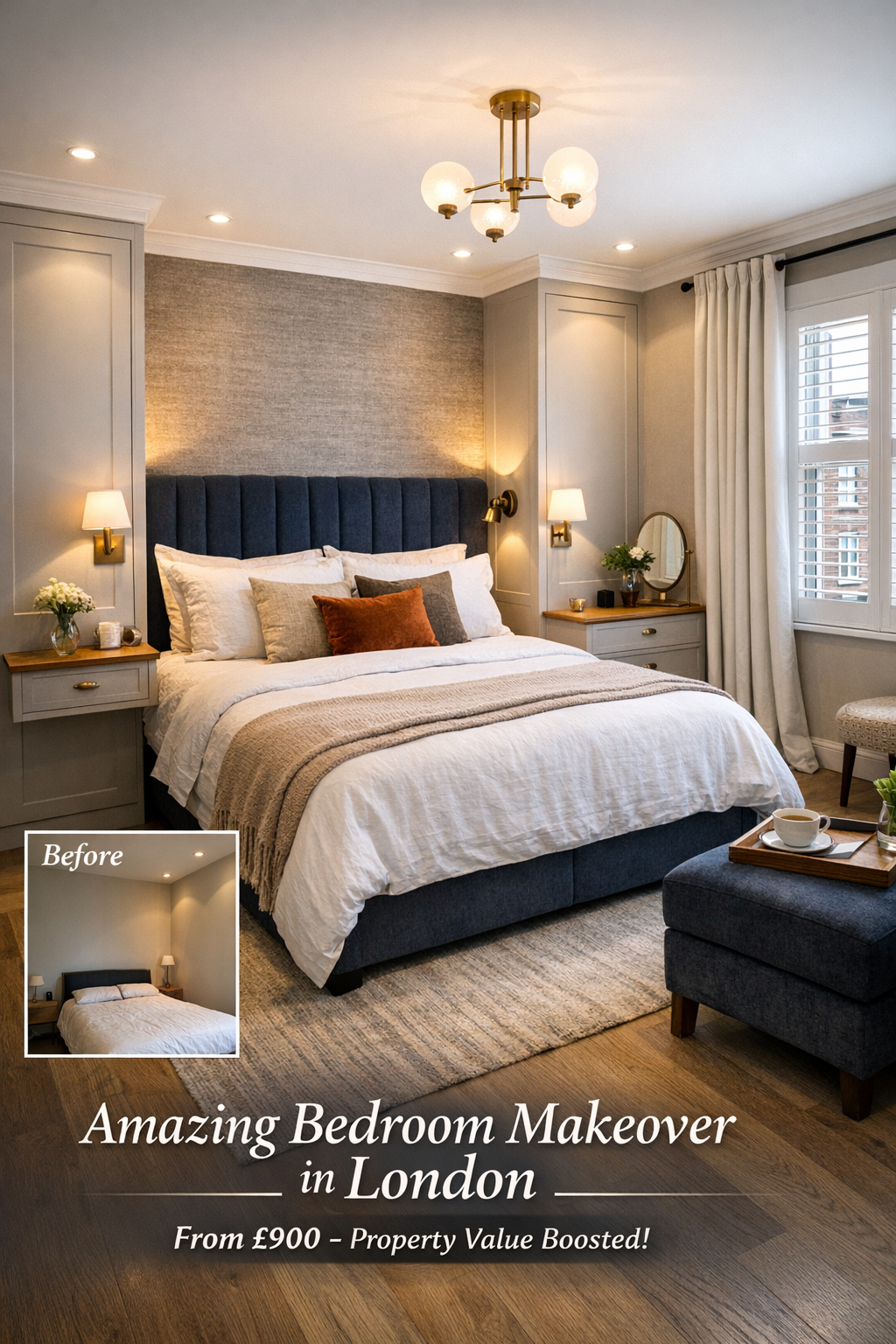
Bedroom Makeovers
Bedroom Makeovers: a London-friendly guide that actually works
If your bedroom feels “fine” but not good, you’re not alone—especially in London, where rooms are often smaller, walls can be wonky (hello, Victorian terraces), and street noise is a real thing. The good news: a bedroom makeover doesn’t have to mean ripping everything out. Done in the right order, it’s one of the quickest ways to make your home feel calmer, more premium, and more functional.
Below is how I’d approach it as a bedroom designer—casual, practical, and budget-aware.
Start here: the 30-minute plan that saves you money
Measure once, thank yourself later

Grab a tape measure and note:
- Room length/width + ceiling height
- Window size and where the radiator sits
- Door swing (this messes up furniture layouts more than people think)
- Any weird bits: alcoves, chimney breasts, sloped ceilings, boxing around pipes
Pick your “Big 3”
Choose three priorities (seriously—just three), like:
- More storage
- Better sleep vibe (calm colours + lighting)
- Quieter room
- Warmer room
- A mini WFH corner
- Easier mornings (wardrobe + mirror + lighting)
That becomes your design filter. If something doesn’t serve your Big 3, it’s probably budget fluff.
Layout first: the easiest way to make a bedroom feel bigger
Put the bed where the room wants it
In many London homes, the “best wall” is usually the one that:
- Doesn’t block the window
- Doesn’t fight the radiator
- Lets you walk around the bed without sideways shuffling
Designer trick: if the room is narrow, use slimmer bedside solutions (wall shelves, sconces, or a single shared floating shelf) so you don’t lose your walkway.
Make circulation feel effortless
A bedroom feels expensive when you can move easily:
- Bed → wardrobe
- Bed → door
- Wardrobe → mirror
If you’re dodging furniture, the room will always feel cramped—no matter how nice the décor is.
Storage that makes the whole room look “done”
Freestanding vs fitted wardrobes (London reality check)
- Freestanding is great if you move often or want flexibility.
- Fitted is brilliant in London because it can swallow awkward spaces (alcoves, chimney breasts, sloped ceilings) and looks more premium.
As a budgeting benchmark: a 3-metre fitted wardrobe with sliding doors is often quoted around the £3,250 range, and some suppliers estimate ~£530–£770 per linear metre depending on spec. (Checkatrade)
The inside matters more than the doors
People obsess over wardrobe door style—then regret the internals. A good internal layout usually includes:
- Double-hang for shirts/jackets
- A proper long-hang section (coats/dresses)
- Drawers for smaller items (so the room stays tidy)
- A top shelf for bulky/seasonal
Customer-style story (anonymised composite):
A couple in a Bethnal Green flat switched from two mismatched wardrobes to one fitted run across an alcove wall. They said mornings instantly felt less stressful because “everything finally had a place,” and the bedroom looked bigger purely because the floor was clear and the lines were clean.
Lighting: the #1 “why does this suddenly look fancy?” upgrade

Use layered lighting (not a single ceiling light)
Think in three layers:
- Ambient: general glow (ceiling light or downlights)
- Task: bedside reading lights / desk light
- Accent: soft wardrobe lighting or picture lights
Adding downlights is often priced as a small “project,” with guides commonly quoting ~£300–£500 per room/project depending on how many lights and access. (Checkatrade)
Add dimmers (seriously)

If you do one lighting upgrade, do dimmers. It’s the difference between “spare room” and “boutique hotel.”
Quick safety note for UK homes
If you’re changing wiring, adding circuits, or doing notifiable work, UK rules (Part P) matter. Registered electricians on competent person schemes can self-certify compliance for notifiable work; otherwise Building Control is involved. (IET Wiring Regulations)
Customer-style story (anonymised composite):
A homeowner near Clapham swapped the main pendant + added wall lights and warm LEDs. Their words: “It stopped feeling like a rental overnight.” They didn’t change furniture—just lighting and paint.
Colour and wall finishes: how to make it calm, not bland

Pick colours based on the light you actually have
London bedrooms can be light-starved, so:
- North-facing rooms often look better with warmer whites and soft earthy neutrals
- South-facing rooms can handle cooler tones without feeling icy
Feature wall, but make it intentional
Best feature walls are usually:
- The headboard wall
- A wall with architectural interest (chimney breast / alcoves)
Wallpapering costs vary wildly by product and prep, but labour-only guides often put wallpapering in the “few hundred pounds per room” ballpark. (Checkatrade)
Designer shortcut: if your walls are uneven (older plaster), a textured wallpaper or panelling detail can look intentional and hide imperfections.
Flooring: comfort + quiet (especially in flats)
Carpet vs engineered wood

Carpet
- Warm, quiet, cosy
- Great for upstairs bedrooms and flats
Typical guides put carpet supply at ~£6–£60 per m² (material only), and a “standard bedroom” supply-and-fit project is often quoted around ~£550–£650 + VAT depending on choice and underlay. (Checkatrade)
Engineered wood
- Cleaner look, great with a big rug
- More stable than solid wood
Materials are commonly quoted around ~£35–£100 per m² depending on quality. (Flooring King)
Flat-owner tip: If you’re above neighbours, check leasehold/building rules about acoustic underlay before committing to hard floors.
Window treatments: the “hotel finish” you feel every day

Curtains that improve sleep (and warmth)
Blackout-lined curtains are a game changer in street-lit areas. Prices vary a lot with fabric and headings, but made-to-measure suppliers show everything from budget-friendly to premium ranges, and some interior firms quote fitting fees as well. (Janet Church Interiors)
Shutters: clean, architectural, and popular in London
Plantation shutters are often quoted in ranges around ~£180–£300+ per m² (and more with full-service measuring/installation). London-specific guides also place them broadly in a similar band depending on style and complexity. (shutters.co.uk)
Comfort upgrades: warmth + quiet (the London specials)
Secondary glazing (for noise + heat loss)
If your bedroom faces a busy road or you’ve got draughty sash windows, secondary glazing can be a strong comfort upgrade. Cost guides often quote a ballpark around ~£300 per m² for a typical window size, with variation by system and window type. (Checkatrade)
Soundproofing: start small before going big
Before you spend serious money:
- Add thick curtains and a big rug with underlay
- Move tall storage onto party walls (it can help)
- Seal gaps around windows/doors
Full soundproofing can range from “targeted fixes” to major build-ups; some UK guides cite averages like ~£2,500 for a room, while others show much larger totals for comprehensive systems. Translation: get quotes and pick the least invasive option that solves your noise problem. (MyJobQuote)
Price guide: what bedroom makeovers typically cost in London
Below are useful planning ranges (your room size, access, building type, and finish level will move the number).
Typical bedroom makeover budgets
| Scope | What you’re doing | Typical London range (materials + labour) |
|---|---|---|
| Quick refresh | Paint + small styling upgrades + minor lighting | £900–£2,500 |
| Refresh + storage focus | Refresh + fitted storage/wardrobes | £4,500–£9,000 |
| Full makeover | Decor + flooring + lighting/electrics tweaks + window treatments | £8,000–£18,000 |
| Luxury / bespoke | Bespoke joinery + premium finishes + acoustic/thermal upgrades | £18,000–£45,000+ |
These ranges are anchored to common UK cost guides for painting, lighting, flooring, electrics, glazing and fitted wardrobes. (MyJobQuote)
Handy line-item costs (for “build your own budget”)
- Paint a small bedroom: ~£250–£400 (guide ranges) (MyJobQuote)
- Fitted wardrobes: ~£3,250 for 3m or ~£530–£770 per linear metre (benchmarks) (Checkatrade)
- Electricians: hourly rates often quoted ~£45–£50+, with London sometimes higher; plug/socket tasks can be in the tens to low hundreds depending on scope (mybuilder.com)
- Downlights: ~£300–£500 per room/project (guide ranges) (Checkatrade)
- Carpet: “standard bedroom” project often quoted ~£550–£650 + VAT depending on selections (Checkatrade)
- Engineered wood materials: commonly ~£35–£100 per m² depending on grade (Flooring King)
- Secondary glazing: often ballparked around ~£300 per m² (varies by system/window) (Checkatrade)
Tips that can add value (or at least make your home easier to sell)
Let’s be real: bedrooms don’t usually “add value” in the way a loft conversion does—but they can increase buyer appeal and help your home photograph and present better.
Value-leaning upgrades buyers notice
- Built-in storage that looks seamless
Buyers love “where will my stuff go?” being solved on day one—especially in London. (And it makes the room look bigger.) - Lighting that flatters the room
Layered lighting + warm bulbs + dimmers makes photos and viewings feel more premium. It’s a high-impact upgrade for the spend. - Declutter-friendly design
Hidden storage, fewer oversized pieces, and clear walkways = calmer, more “move-in ready” presentation. - Comfort upgrades in noisy or cold areas
Secondary glazing and heavy-lined curtains can be a genuine selling advantage on busy roads. (Checkatrade)
About “property value uplift” claims
You’ll see various claims around staging increasing sale prices. The most honest takeaway: results vary, but presentation can absolutely affect speed of sale and buyer perception—especially in competitive markets. One UK example in The Times describes staging helping a previously slow-to-sell home finally move after decluttering/restyling (not a guarantee, but a good illustration of the effect). (The Times)
Customer-style story (anonymised composite):
A landlord in Zone 2 refreshed a tired bedroom: warm white paint, blackout curtains, proper bedside lighting, and a fitted wardrobe. They didn’t claim “X% value added,” but said viewings felt smoother because people stopped commenting on storage and started commenting on how calm the room felt—which is basically the point.
Pros and Cons of a bedroom makeover
Pros
- One of the highest “feel-good” returns per pound
- Better storage and lighting improves daily life immediately
- Presentation upgrades can support saleability and buyer confidence (The Times)
Cons
- Budgets creep fast once you add wardrobes, flooring and electrics
- Fitted elements reduce flexibility if you like rearranging
- In flats, building rules (noise, flooring, work hours) can limit options
Bedroom Makeover FAQ (London edition)
How long does a bedroom makeover take?
- Refresh: a few days (paint + lighting + styling)
- Full makeover: 1–3+ weeks depending on joinery lead times and trade availability
Do I need planning permission?
Usually no for internal changes like decoration, fitted wardrobes, and lighting. Exterior changes (new windows) or listed buildings/conservation areas are different—check before you start.
Do I need Building Control for electrics?
Some work is notifiable under Part P. Using a registered electrician on a competent person scheme is the simplest way to keep paperwork clean. (IET Wiring Regulations)
What’s the fastest way to make it feel “luxury”?
- layered lighting + dimmers, 2) upgraded curtains, 3) a larger headboard or statement wall, 4) fewer but better-sized accessories.
Are fitted wardrobes worth it?
In many London bedrooms: yes, especially in alcoves and awkward spaces. Benchmarks often sit around £3,250 for a 3m run or £530–£770 per linear metre depending on spec. (Checkatrade)
Carpet or engineered wood?
- If you want cosy + quiet: carpet
- If you want crisp + modern: engineered wood with a large rug (and check acoustic needs in flats) (Checkatrade)
What if my bedroom is noisy?
Start with curtains + rug/underlay and sealing gaps. If it’s still bad, explore secondary glazing and targeted soundproofing quotes. (Checkatrade)
A simple “designer order of work” you can follow
If you’re unsure where to start, follow this sequence:
- Layout plan
- Storage plan
- Lighting plan
- Decoration (paint/wall finish)
- Flooring
- Curtains/shutters
- Styling + final touches

Comment (1)
[…] “nice bedroom,” and then there’s bedroom retreat—the kind of space that makes you breathe out the second you walk in. In London, coziness isn’t […]
Comments are closed.