


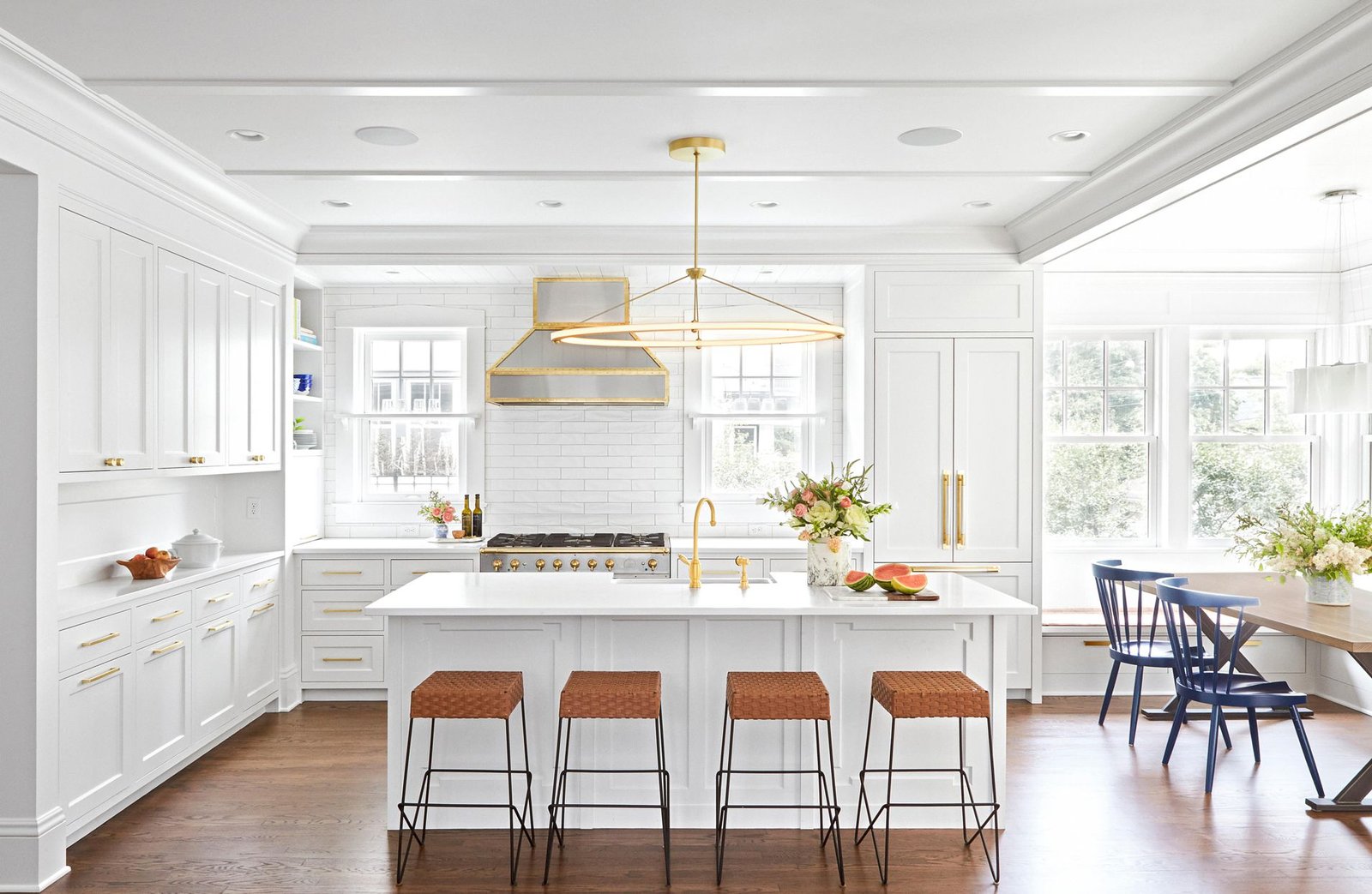
Open Concept Kitchen Ideas (That Actually Work in London Homes)
Open-Plan Kitchen Ideas That Really Work in London Homes
If you’ve ever stood in a classic London terrace kitchen thinking, “Why is it so dark and chopped up back here?”—you’re not alone. Open-concept kitchens (and their slightly-more-practical cousin, broken-plan) can completely change how your home feels: brighter, more social, and usually more useful day-to-day.
But here’s the honest designer take: the best open-plan kitchens aren’t the ones with the fanciest Pinterest island. They’re the ones that nail layout, storage, ventilation, and zoning, so the space stays calm even when life gets messy.
Let’s walk through ideas that work especially well for London houses and flats—and what they tend to cost.
What “Open Concept” Really Means (and Why “Broken-Plan” Is Having a Moment)

Open concept usually means your kitchen, dining, and living space flow together without full walls.
Broken-plan is the hybrid approach: you keep the openness, but add subtle dividers so each zone feels intentional (think glazing, partial walls, shelving, pocket doors). It’s basically “open-plan, but smarter for real life.” House & Garden describes it as a hybrid of open-plan and closed rooms using subtle dividers to create zones. House & Garden
London reality check: In busy homes (kids, flatmates, working from home), broken-plan often wins because it reduces noise and mess-stress without killing daylight.
Start With a Quick “London Home” Space Audit

Before you pick finishes, do this 10-minute check:
1) How wide is your space—really?
A lot of London kitchens look bigger in photos than they are. Measure:
- the narrowest walkway
- where doors open
- where your dining chairs would pull out
- where you’ll stand when the dishwasher is open
2) Where does daylight come from?
Terraces often have the “dark middle” problem. Your open-plan design should help pull light deeper into the home—sometimes glazing or rooflights matter more than removing every wall.
3) What can you actually change?
- Load-bearing walls may need structural design + steel (RSJ).
- Flats/leaseholds: you may need permissions (freeholder/managing agent).
- Party walls in terraces: structural openings often touch shared walls.
The Most Popular Open-Concept Layouts for London Homes

A) The “Knock-Through” Kitchen–Diner (classic London upgrade)
Usually: remove the wall between kitchen and dining room.
Why it works:
You get a bigger kitchen without extending, and the dining zone naturally keeps the space feeling like a “room,” not a warehouse.
Designer tip: Put your dining table where it visually “belongs”—often near a window or in line with ceiling lighting.
B) The Rear Extension Open-Plan (the dream setup)

This is the London renovation poster-child: rear/side return extension + big kitchen-diner-family room.
Make it feel good, not echo-y:
Plan zones (kitchen here, dining there, sofa area there) instead of treating it as one big rectangle.
Cost note: single-storey extension costs vary widely, but London ballparks often land around £2,300–£3,400 per m² depending on design/site/finish. RISE Design Studio+1
C) Open Galley + Peninsula (underrated for narrow terraces)

If your kitchen is narrow, a huge island can choke circulation. A peninsula gives the “open-plan social edge” without ruining walkways.
Best for: Victorian terraces and tight footprints where an island would be a pain.
D) U-Shape With a Breakfast Bar (small-space hero)
A U-shape with a short bar can create:
- great worktop flow
- strong storage
- a natural boundary between kitchen and living
Zoning Ideas That Make Open-Plan Feel Calm (Not Chaotic)
This is where open-plan succeeds or fails.
1) Island zoning (when it fits)
An island should do at least two jobs:
- prep + storage
- seating + social hub
(Otherwise it’s just a big obstacle.)
If you’re constantly hosting: keep seating on the living/dining side, and prep/cook facing out so you’re not cooking with your back to everyone.
2) Peninsula zoning (often better than an island)
Peninsulas:
- cost less than islands (less flooring + less space planning)
- create a clear kitchen boundary
- work in narrow London layouts
3) Glazed partitions (the “broken-plan” cheat code)
A steel/glazed screen:
- keeps light moving
- reduces noise
- contains cooking mess visually
…and it looks great.
This is especially popular for families who want a living room that feels like a living room.
4) Pocket doors (open when you want, close when you don’t)
Perfect when:
- someone is on a work call
- kids are watching TV
- you’re frying something dramatic and don’t want the sofa smelling like it
5) Lighting zones (instant “designed” feel)
Think layers:
- Task lighting: under-cabinet, prep areas
- Feature lighting: pendants above dining or island
- Ambient: warm, dimmable general lighting
Lighting is how you make one big space feel like three purposeful spaces.
Kitchen Concept Ideas That Are Popular Right Now (and Actually Practical)
Broken-plan layouts
As above: it’s open-plan with smarter zoning—and it’s popular because it solves the biggest open-plan complaints. House & Garden
Kitchen nooks & banquette seating

Banquettes are back because they’re cosy, space-efficient, and they “anchor” the dining zone. House & Garden has loads of kitchen nook inspiration for this exact idea. House & Garden
Warm, textured kitchens (less sterile)

Recent design coverage is heavily leaning toward warmth, texture, and personality—less “bright white showroom,” more lived-in comfort. Good Housekeeping
Statement colour (but done sensibly)
Colour trends change fast, but the bigger point is: people want kitchens that feel personal, not generic. Good Housekeeping
The Unsexy Stuff That Makes Open-Plan Work: Storage + Ventilation
Storage: you need more than you think
In open-plan, mess is visible. So the design should hide it:
- deep drawers instead of too many cupboards
- integrated bins/recycling
- appliance garage (toaster/coffee bits)
- tall larders to keep worktops clear
Ventilation: non-negotiable in open-plan
Cooking smells spread much more in open layouts, so good extraction matters. Houzz
For Building Regulations (Part F), the minimum kitchen extract rates for intermittent extraction are typically:
- 30 l/s where a cooker hood extracts to outside
- 60 l/s where there’s no outside extraction (e.g., recirculating-only setups) GOV.UK
And importantly: a recirculating hood alone doesn’t comply as a means of ventilation under Part F. GOV.UK
In plain English: if your kitchen opens to your living area, try to extract to outside if at all possible.
Open-Plan + Fire Safety: The Staircase Question (Don’t Ignore This)
Open-plan decisions can affect escape routes—especially if opening up around a stair.
Government fire safety guidance notes that a protected stairway is typically enclosed with fire-resisting construction and fire doors to protect escape down the stairs. GOV.UK
I’m not saying “don’t do open-plan.” I’m saying: involve Building Control and a competent designer/architect early if you’re altering layouts near stairs—especially in terraces and flats.
Real-World Client Experiences (Composite Stories From London Projects)
These are composite examples based on common patterns I see (not one identifiable homeowner).
1) “We loved the open space… until the noise drove us mad”
A couple in a North London terrace knocked through kitchen + dining + snug. It looked amazing—until every pan sizzle competed with the TV.
Fix: glazed screen + soft furnishings + quieter appliance choices.
Takeaway: If you hate noise, go broken-plan from the start.
2) “The island was the dream… but it ruined the flow”
A family insisted on a big island. After mock-taping it on the floor, it was obvious the walkways would be tight with kids running through.
Fix: swapped to a peninsula + better storage.
Takeaway: You don’t need an island to have an open-plan kitchen people love.
3) “We didn’t plan storage, so the whole living room looked messy”
Open-plan meant the washing-up, recycling, and countertop clutter were always visible.
Fix: tall pantry + integrated bins + “appliance zone.”
Takeaway: Open-plan needs more storage planning than a closed kitchen.
Costs in London: What You’ll Likely Spend (With a Handy Table)
Prices vary wildly depending on finish level, access, and whether you’re moving services/doing structural work. But these are useful starting points.
Typical cost ranges (UK, often higher in London)
| Item | Typical range | Notes |
|---|---|---|
| Kitchen design fees | £770–£4,600 | Varies by scope/detail. Checkatrade |
| Kitchen supply (mid-range) | £10,000–£20,000 | Cabinets/worktops/appliances vary. MyJobQuote |
| Kitchen fitting (installation) | £2,000–£6,000 (avg ~£3,500) | A commonly quoted UK average is ~£3,500. Checkatrade |
| Remove load-bearing wall | £1,250–£1,750 | Structural opening cost band. Checkatrade |
| RSJ / steel beam | ~£800–£950 | Often additional/linked to wall removal. Checkatrade |
| Structural engineer | ~£200 per visit | Budget for surveys/calcs/visits. Checkatrade |
| Single-storey extension (London ballpark) | ~£2,300–£3,400 per m² | Site/design/finish changes this a lot. RISE Design Studio+1 |
Quick “project type” totals (very rough)
- Cosmetic refresh (no structural work): often £8k–£25k depending on kitchen quality
- Knock-through + new kitchen: commonly £20k–£45k+
- Extension + new kitchen: commonly £60k–£150k+, depending on size/spec
Pros and Cons of Open-Concept Kitchens
Pros
Here are strong pros of an open-concept kitchen (written in a practical, homeowner-friendly way—great for your article):
- More social cooking: You can cook and still talk to family/guests instead of being stuck in a separate room.
- Better flow for entertaining: Food, drinks, and people move naturally between kitchen, dining, and living areas.
- Brighter spaces: Removing walls helps daylight travel through typical London layouts (especially terraces and flats).
- Feels larger without adding square metres: Even if the footprint stays the same, open-plan makes the home feel more spacious.
- More flexible living: One space can handle weekday routines (homework, working from home) and weekend hosting.
- Easier family supervision: You can keep an eye on kids while cooking.
- Improved layout efficiency: You can position the dining table, island/peninsula, and storage where they actually make sense.
- Great “hub” for modern life: The kitchen becomes the centre of the home, not a back-room utility space.
- Potential to add value: Many buyers actively want an open-plan kitchen-diner, so done well it can improve resale appeal.
- Stronger design impact: A well-designed kitchen carries the look of the whole ground floor because it’s always on view.
Cons
1) Cooking smells spread everywhere
When the kitchen is open to the living/dining area, odours travel fast and can hang around in soft furnishings (sofas, curtains, rugs). Good extraction helps, but it’s still more noticeable than in a closed kitchen.
2) Noise travels (more than you expect)
Extractor fans, clanging pans, boiling kettles, and appliances like dishwashers become part of the “living room soundtrack.” In smaller London homes this can feel constant.
3) Mess is always on show
You can’t shut the door on:
- washing up
- food prep clutter
- bins/recycling
- kids’ stuff migrating onto the island
Open kitchens tend to require better storage habits (or more hidden storage).
4) Harder to control temperature
Cooking heat spreads into the whole space. In summer, open-plan areas can feel warmer—especially with lots of glazing or rooflights.
5) Less privacy / less separation
If someone is watching TV, working from home, or putting a child to bed, the open space can make it harder to have “quiet zones.”
6) More planning needed for lighting and zoning
Without walls, you need to deliberately create zones with lighting, furniture, and sometimes partitions—otherwise the space can feel like one big room with no purpose.
7) Ventilation and fire/escape considerations can get more complex
Depending on your home layout (especially around staircases), fully open layouts can trigger extra considerations, so it’s worth checking early if you’re doing structural changes.
Step-by-Step: How I’d Plan This as Your Designer
1) Define how you live
- Do you host often?
- Do you want a quieter living area?
- How many seats do you need daily vs occasionally?
2) Choose open-plan vs broken-plan
If you want calmer living: choose broken-plan.
3) Lock the layout before choosing finishes
Layout mistakes are expensive. Finishes are flexible.
4) Solve ventilation + storage on paper
Especially if kitchen + living are one space.
5) Then design the vibe
Cabinet style, colours, lighting, floors, hardware—this is the fun part.
FAQ: Open Concept Kitchens for London Homeowners
Do I need planning permission to make my kitchen open-plan?
Often no for internal changes, but it depends on your property (listed buildings, conservation areas, flats/lease rules). Always check your specific situation.
Do I need Building Control if I remove a wall?
If it’s structural or affects fire safety/escape, Building Control is commonly involved—especially around stairs. GOV.UK
How do I know if a wall is load-bearing?
Don’t guess—get a structural engineer. The cost of being wrong is painful.
Are recirculating cooker hoods enough in open-plan?
Recirculating hoods can help with odours, but on their own they don’t provide compliant ventilation under Part F. GOV.UK
What extraction rate should I aim for?
Part F guidance includes minimums such as 30 l/s (extract to outside) and 60 l/s (no outside extract). GOV.UK
Island or peninsula—which is better for London homes?
If you have the space and want a social hub, island. If you’re tight on width (many terraces), peninsula is usually the smarter choice.
How do I stop open-plan feeling noisy?
Soft furnishings, rugs, acoustic panels, and (big one) broken-plan screens/doors when needed.
What is the best layout for an open kitchen?
There isn’t one “best” open-kitchen layout for everyone—the best one is the layout that fits your room width, where the doors/windows are, and how you actually cook. But in practice, these are the winners most often:
The best all-rounder: L-shape + island
Best when you have enough width for comfortable walkways.
- Why it’s great: strong workflow, loads of worktop/storage, island becomes the social hub.
- Works best if: you can keep clear circulation all the way around the island (so people aren’t squeezing past the dishwasher or hob).
Best for narrow London footprints: Galley + peninsula
This is the “terrace house” favourite.
- Why it’s great: you get the open-plan feel and seating without an island choking the room.
- Works best if: the space is long and not very wide, or you need a clear route to the garden.
Best for small/medium spaces: U-shape + breakfast bar
- Why it’s great: super efficient cooking zone and lots of storage.
- Works best if: you want maximum worktop and a natural boundary to dining/living.
Best for entertaining: Island facing the living/dining
- Put seating on the living side, prep/cook facing out.
- Keeps you engaged with guests instead of cooking with your back to everyone.
Quick rule to choose fast
- If your space is wide enough → L-shape + island
- If your space is narrow → galley + peninsula
- If you want maximum efficiency/storage → U-shape + bar
If you tell me your room width/length (even rough), and where the door to the garden is, I’ll point you to the best layout and where the island/peninsula should go.
What is the 60 30 10 rule for kitchens?
In kitchens, the 60/30/10 rule is a simple colour + material balance guideline designers use so the space looks cohesive (not busy, not flat):
- 60% = dominant/base (the main “background” look)
- 30% = secondary (supporting colour/material)
- 10% = accent (the pop/contrast)
This is the same classic interior design proportion rule used across rooms, and it’s often applied specifically to kitchens via cabinets/worktops/splashbacks/hardware.
Kitchen examples (easy to visualise)
Example 1: Clean + timeless
- 60%: light cabinets/walls
- 30%: worktop + flooring tone (stone/wood)
- 10%: brass/black handles + tap + lighting
Example 2: Two-tone kitchen
- 60%: main cabinets (e.g., warm white)
- 30%: island or tall units (e.g., navy/green)
- 10%: accent (e.g., splashback tile, hardware, bar stools)
Quick tips so it works in real kitchens
- Keep 60% fairly neutral (especially in open-plan London homes).
- Put the 30% on something substantial (island, tall run, worktop, floor).
- Use 10% as “repeatable accents” (handles, pendants, tap, small décor) so it feels intentional.
What is the 3×4 kitchen rule?
The 3×4 kitchen rule is a practical layout guideline about counter space, not room size.
It means: aim for 3 separate countertop zones, each about 4 feet (≈1.2m) long, dedicated to the main tasks:
- Prep zone (chopping/mixing)
- Cook zone (next to the hob/oven)
- Clean zone (next to the sink/dishwasher)
The idea is to reduce clutter and cross-contamination (raw food, dirty dishes, cooked food don’t fight for the same worktop), and to make cooking smoother.
How to use it in real (London-sized) kitchens
- If you can’t get full 4-foot runs, don’t panic—treat it as a goal, then scale it down.
- A peninsula or island often helps create that extra “4-foot” prep zone.
- Even a pull-out worktop or a clear section of counter you protect from appliances can act as one of the zones.
What are the disadvantages of an open kitchen?
- Noise travels: extractor hum, dishwasher, pans—everything.
- Mess is visible: you can’t “close the door on it.”
- Smells spread: ventilation matters more than ever (especially with sofa nearby). GOV.UK+1

Comment (1)
[…] Before we jump in, here’s a helpful companion read from our earlier topic: Open Concept Kitchen Ideas. […]
Comments are closed.