


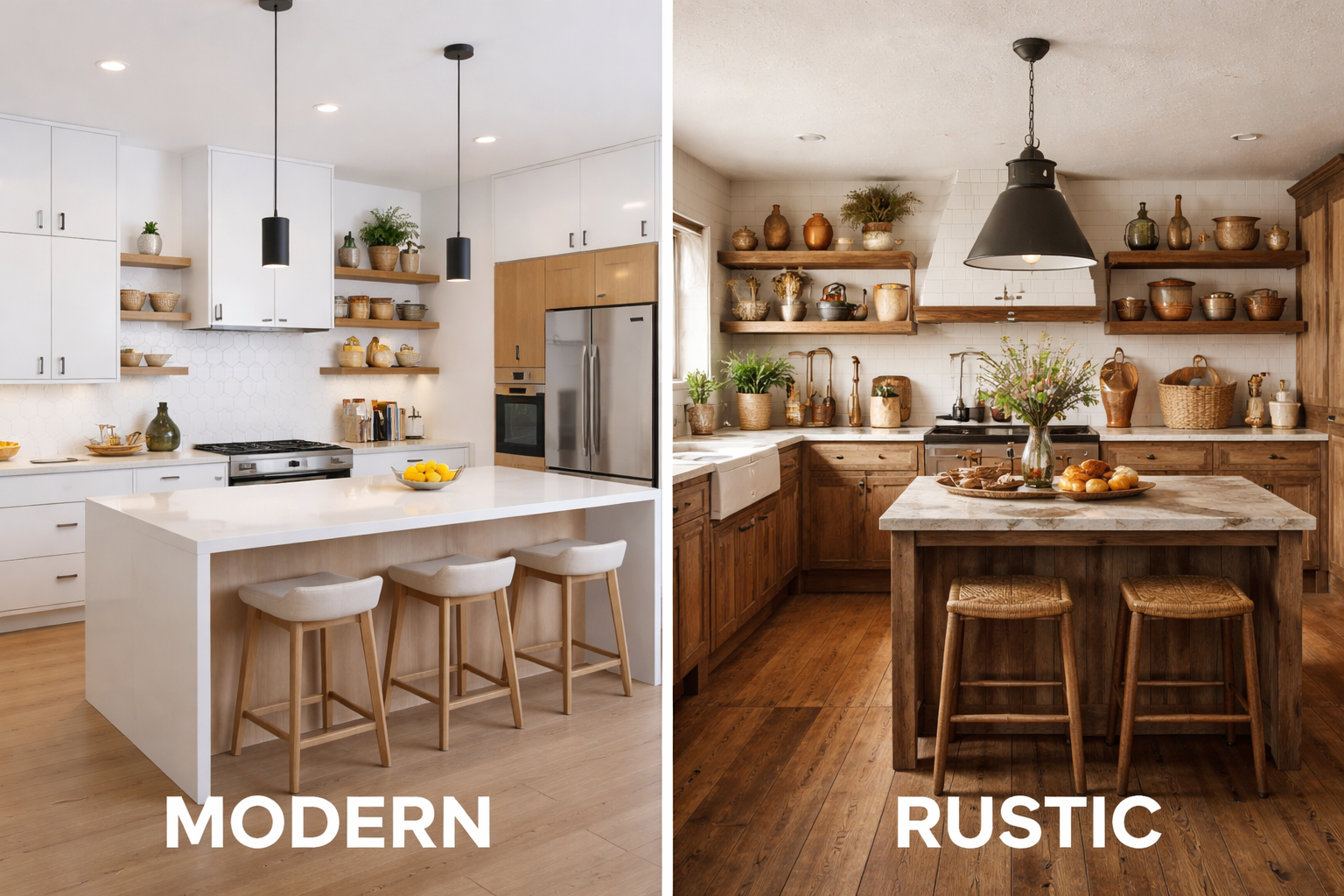
Modern vs. Rustic Kitchen Design (London Homeowners Guide)
Intro – Modern vs. Rustic Kitchen Design
If you’re stuck between a sleek modern kitchen and a warm rustic one, you’re basically choosing between two different “moods” — and in London, the right choice often comes down to your home type, light levels, and how much daily chaos you want the kitchen to hide.
This guide breaks it down like I would with a client: what each style really looks like in real homes, what it costs, what helps resale, and how to avoid the common regrets.
What “Modern” and “Rustic” actually mean
Modern kitchens (in real life)

- Clean lines, minimal visual clutter
- Often handleless or slim, linear handles
- Integrated appliances and “everything has a place” storage
- Works brilliantly in compact London kitchens because it visually reads bigger
Rustic kitchens (done well, not “busy”)

- Warmth, texture, natural materials, character
- Shaker or framed doors, timber tones, tactile finishes
- Can be timeless in period homes — if you keep it edited
London reality: most people land on a hybrid
Houzz’s UK study shows the top kitchen styles remain contemporary (28%), modern (20%), and traditional (11%). (Houzz)
That mix is why “modern rustic” (clean layout + warm materials) is so common — it’s practical and inviting.
A quick decision framework (choose faster)
Ask yourself:
- Is your kitchen small or dark?
Modern usually helps small/dark spaces feel bigger. Rustic can work too, but you need tighter control of texture and colour. - How tidy is real life?
Rustic can be forgiving (patina, texture). Modern can look amazing… but some finishes show fingerprints easily. - Are you selling in the next 1–3 years?
Lean “timeless” and broadly appealing. In London, a calm, well-lit, well-fitted kitchen tends to win regardless of style. - Do you live in a period home?
Rustic (or modern classic) often suits original details better. Ultra-minimal modern can still work — you just need it to feel intentional, not out of place.
Side-by-side design comparison
Cabinetry and doors
Modern
- Flat slab doors, tight gaps, minimal trims
- Handleless rails or discreet handles
- Looks best when you keep lines uninterrupted (tall banks, integrated fridge)
Best for: flats, modern builds, small galleys, open-plan spaces.
Rustic

- Shaker, framed doors, tongue-and-groove looks
- Painted timber tones or natural wood
- Works when the design is “simple rustic,” not overly decorative
Best for: Victorian/Edwardian/Georgian homes, mews houses, and anyone who wants warmth.
Typical client scenario:
A couple in a Victorian terrace wanted rustic, but their kitchen was narrow and north-facing. We kept shaker doors (rustic-friendly) but used a modern layout and minimal hardware. Result: warm and visually calm — the kitchen felt larger without losing character.
Worktops
Modern favourites
- Quartz/engineered stone for durability and consistency
- Sleek edges, waterfall panels for drama (in larger spaces)
Rustic favourites
- Wood (beautiful, but needs care)
- Stone-look or textured surfaces that feel natural
Designer tip for London life:
If you cook a lot or rent the property out, prioritise stain resistance and low maintenance first — then add rustic warmth through doors, lighting, and hardware.
Splashbacks
This is where style shows up fast.
Houzz UK reports a strong move toward larger-format slab splashbacks (62%), with tiles still popular (38%). (Houzz)
Modern splashback direction
- Slab splashback (less grout, cleaner look)
- Full-height coverage for a seamless finish
Rustic splashback direction
- Warmer tiles, handmade-look textures
- Keep patterns controlled in small kitchens (too much “movement” can feel busy)
Flooring
Modern

- Large-format porcelain, consistent tones
- Minimal grout lines (easier visually and practically)
Rustic

- Engineered wood (warm underfoot)
- Stone-look tile for a farmhouse vibe with easier maintenance
London practicality: if you’re in a flat, check building rules about sound insulation and underlay before committing to timber.
Colour palettes
Modern

- Whites, greys, blacks, deep greens/blues used in blocks
- Looks best when you keep the palette tight (2–3 main tones)
Rustic
- Warm neutrals, earthy greens, clay tones, timber
- The goal is warmth without clutter
Small/dark kitchen trick: use rustic warmth on one element (like oak shelves or a timber breakfast bar), not every surface.
Hardware and metals
Modern

- Linear handles, minimal pulls, black/brushed finishes
- Consistency is key (don’t mix too many metals)
Rustic
- Aged brass, antique bronze, tactile knobs
- Looks best when it feels “considered,” not random
Lighting (the thing that makes both styles work)
Modern lighting
- Crisp downlights + strong under-cabinet task lighting
- Clean, shadow-free worktops
Rustic lighting
- Warmer layered lighting + a simple pendant or two
- Soft glow that makes timber and texture look great
Client scenario:
A mews house kitchen leaned rustic but felt gloomy. We didn’t change the style — we layered lighting properly. The homeowner’s feedback was basically: “Now it looks expensive at night.”
Appliances and extraction (especially important in London)
Modern kitchens often hide appliances behind panels — great for a clean look. Rustic kitchens sometimes feature statement ranges — great if the room can handle the scale.
London reality check: In many flats, ducting is limited, so extractor choice matters a lot. A beautiful kitchen that smells like last night’s frying… doesn’t feel premium.
Cost and budget guide (UK + London planning numbers)
Prices vary hugely by spec and how much you move plumbing/electrics — and London logistics can push labour up. Checkatrade notes labour can be higher in cities (especially London). (Checkatrade)
Here are useful “starting point” numbers:
| Cost item | Typical UK figure | What it includes |
|---|---|---|
| Median spend (major + minor kitchen renovations) | £17,500 | Houzz UK 2025 study median (Houzz) |
| Median spend (major small kitchen renovation <100 sq ft) | £4,900 | Houzz UK 2025 study (Houzz) |
| Kitchen fitting (labour only) – average | £3,500 | Checkatrade (Checkatrade) |
| Kitchen fitting (labour only) – range example | £2,000–£6,000 | Checkatrade (Checkatrade) |
| Average kitchen fitting cost (labour only) – alternative estimate | ~£1,700 | MyJobQuote (2026 update) (MyJobQuote) |
Style pricing note: modern vs rustic can land in similar totals at mid-range. Rustic sometimes costs more if you go heavy on timber detailing, decorative trims, or tile-heavy surfaces; modern can climb if you choose premium handleless systems, slab splashbacks, and integrated appliances.
Tips that can add value (and help the home sell better)
First: no one can promise a guaranteed uplift — market conditions matter. But you can design in ways that buyers consistently respond to.
What tends to add value in London (regardless of style)
- A bright, well-lit kitchen (task + ambient lighting)
- Great storage (pantry/tall banks/drawers)
- Strong extraction/ventilation
- Clean installation details (aligned doors, neat finishes, tidy junctions)
What sources say about value
- Checkatrade suggests a new kitchen can add around 6–8% value (their guidance is general). (Checkatrade)
- HomeOwners Alliance says a kitchen refresh costing around £4,000 could add £17,000 to a London property (based on their research partners). (HomeOwners Alliance)
Treat these as indicative examples, not promises.
Style-specific “value-friendly” tips
Modern that sells well
- Avoid ultra-trendy colours that date quickly
- Keep surfaces durable and easy to maintain
- Add warmth with timber accents + warm lighting so it doesn’t feel cold
Rustic that sells well
- Keep rustic “clean” (simple shaker, warm neutrals, limited open shelving)
- Use texture as an accent, not a takeover
- Choose timeless tiles rather than loud patterns (especially in small kitchens)
Client scenario (selling angle):
A homeowner chose a “modern rustic” mix for a 1930s semi: simple shaker fronts, quartz worktops, slab-style splashback, warm brass accents. When they sold later, the estate agent feedback was that the kitchen felt “finished” and buyers didn’t mentally subtract renovation costs. That’s often how value shows up in the real world.
Pros and Cons
Modern kitchens
Pros
- Makes small kitchens feel bigger (less visual noise)
- Easy to keep cohesive and “new”
- Great for open-plan London layouts
Cons
- Some finishes show fingerprints/scratches
- Can feel cold if lighting/materials aren’t warm enough
Rustic kitchens
Pros
- Warm, characterful, forgiving
- Works beautifully with period details
- Feels homely and timeless when kept simple
Cons
- Can look cluttered faster (needs editing)
- Some materials need more upkeep (wood worktops, grout-heavy tiles)
FAQ (London homeowner edition)
Which is better for a small London kitchen?
Often modern (or modern-leaning) because it reduces visual clutter. Rustic works too — just keep it simple and avoid too many textures at once.
What’s the most resale-friendly option?
A timeless hybrid: clean layout + warm materials. Houzz UK shows modern/contemporary styles are very common, but traditional still plays a role. (Houzz)
Are slab splashbacks “too modern” for rustic kitchens?
Not necessarily — a slab splashback can actually make a rustic kitchen feel more refined and easier to maintain. Houzz UK reports slab splashbacks are widely chosen. (Houzz)
How much should I budget in London?
Use the Houzz median (£17,500) as a reality check for overall spend, then adjust for size/spec and London labour/logistics. (Houzz)
How do I stop a modern kitchen feeling cold?
Warm lighting, wood accents, textured splashback, and softer paint tones (not everything grey/white).
How do I stop rustic feeling dated?
Keep door style simple, limit open shelving, avoid overly themed décor, and choose classic hardware.