


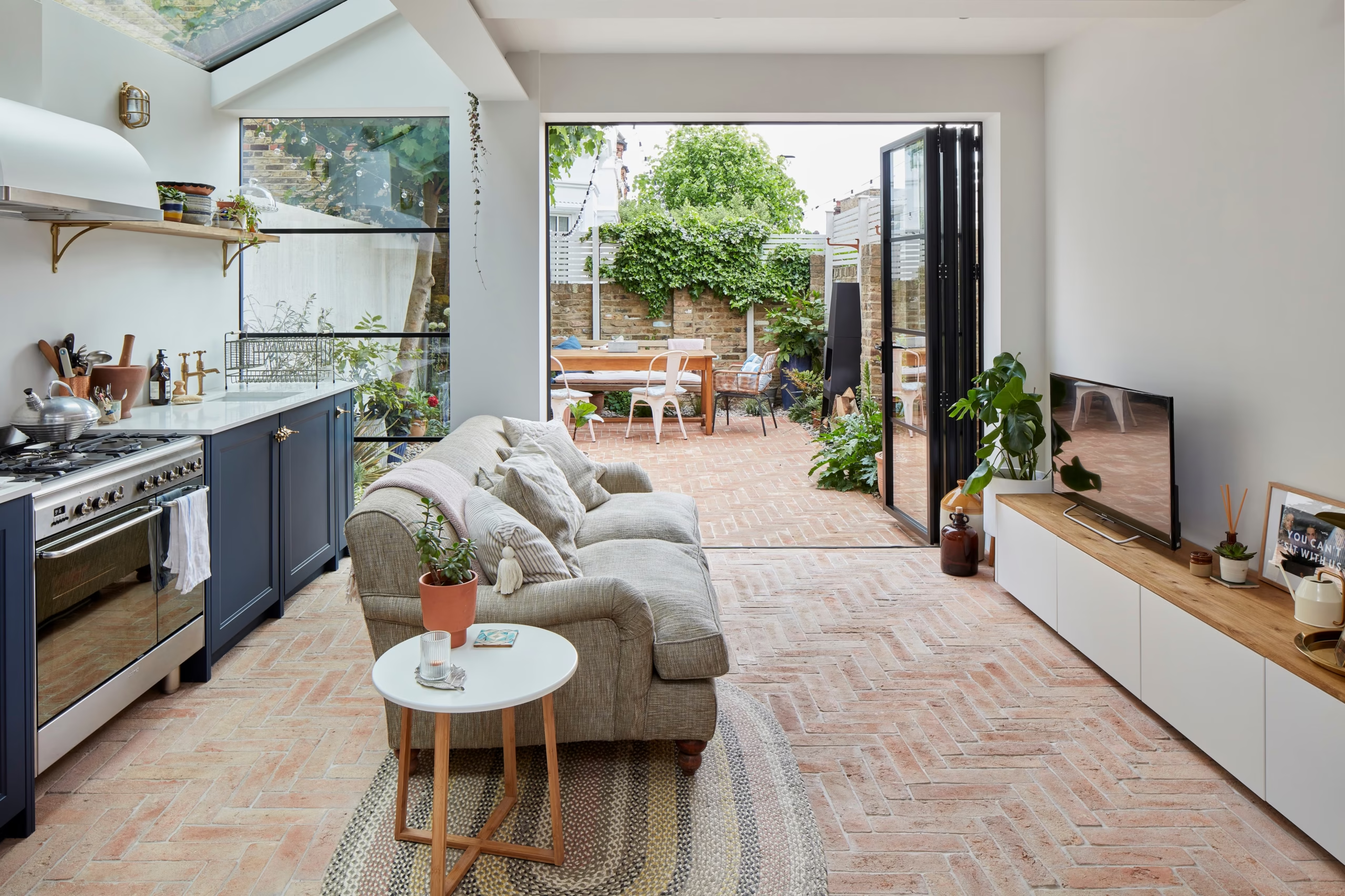
Transform Your Kitchen with These Open Concept Ideas (London Homeowners)
Open Concept Ideas for your Kitchen

If your kitchen feels boxed-in, dark, or cut off from the rest of the house, you’re in very good London company. Terraces, mansion blocks, and conversions often have tight footprints and awkward layouts that don’t match how we live now.
The good news: you don’t need a massive extension to transform it. You need a smart “open concept” plan that balances flow, zoning, storage, and ventilation—so it looks great and stays practical on a random Tuesday night.
Before we jump in, here’s a helpful companion read from our earlier topic: Open Concept Kitchen Ideas.
Open-Plan vs Broken-Plan: Pick the Right Kind of “Open”
Open-plan
This is the full knock-through vibe: kitchen + dining + (sometimes) living all together.
Best for: entertaining, daylight flow, and making small spaces feel bigger.
Broken-plan
This is the “London-friendly” version: still open and bright, but divided into zones using subtle separators (glazing, shelving, partial walls, pocket doors, level changes).
House & Garden describes broken-plan as a hybrid of open-plan and closed rooms using subtle dividers to create distinct zones.
Resi also frames it as creating “pockets/zones” while keeping the open-plan benefits.
Designer take: If you’re worried about noise, smells, or seeing the washing up from the sofa, broken-plan is usually the sweet spot.
A Designer’s “London Space Audit” (10 Minutes That Saves You Money)
Before picking islands and colours, check:
- Room width + walkways: Can people pass each other with drawers open? Can chairs pull out without blocking the route?
- Door swings + pinch points: Back doors, under-stair doors, and hallway openings matter a lot in terraces.
- Daylight path: Open-plan should pull light deeper—especially in the “dark middle” of a terrace.
- Structure + services: Chimney breasts, soil stacks, and where water/gas/electrics run can make (or break) a layout.
Quick client-style insight (composite):
One family wanted a huge island “because Pinterest.” We taped it on the floor and instantly realised the walkway would be tight with the dishwasher open. We switched to a peninsula and the space immediately felt bigger—and it was cheaper too.
Best Open Concept Layouts That Actually Work in London Homes
1) Knock-through kitchen–diner (the classic terrace upgrade)

Open the wall between the kitchen and dining room and you get an immediate upgrade.
Why it works in London: You gain space without extending, and the dining area naturally acts like a “zone.”
Make it feel designed: add a dining pendant, a rug, or banquette seating to anchor that area.
2) Rear extension kitchen–diner–family room (the big transformation)

If you’re extending, open-plan is often the goal—big glazing, rooflights, and a proper hub.
Cost reality: London extension costs vary heavily, but common London ballparks for single-storey extensions are often quoted in the ~£2,500–£4,000 per m² range depending on spec and complexity.
Pro tip: Don’t design one giant rectangle—design three zones: kitchen / dining / living.
3) Galley + peninsula (the narrow-terrace hero)

For long, tight spaces, a peninsula often beats an island.
Why it works: You get seating + zoning, but keep circulation clear (especially the route to the garden).
4) U-shape + breakfast bar (maximum efficiency)
This is a storage and workflow champion.
Best for: small-to-medium kitchens where you want a strong “cooking zone” plus a social edge.
Zoning Tricks That Make Open-Plan Feel Calm (Not Chaotic)
Islands that earn their space

An island should do at least two jobs (prep + storage, seating + storage, etc.)—otherwise it’s just a big obstacle.
Peninsulas (often the smarter London choice)

Peninsulas:
- create a natural boundary
- cost less than many island builds
- work better in narrower properties
Broken-plan dividers that keep light
- Glazed screens
- shelving dividers
- pocket/sliding doors
- half walls (great for hiding mess without killing openness)
Broken-plan is explicitly about subtle dividers creating zones while keeping openness. House and Garden
Lighting zones (this is where “designer” happens)

Use layers:
- task lighting (prep areas)
- feature lighting (dining/island)
- ambient lighting (dimmable general)
What’s Popular Right Now (And Why London Homeowners Love It)
Here are the open-concept ideas clients are asking for most:
- Broken-plan layouts for calmer living (open, but not chaotic).
- Internal glazing to reduce noise while keeping light.
- Banquette seating / dining nooks to anchor the dining zone (especially in terraces).
- Tall pantry/larder walls to keep worktops clean in open-plan living.
- Warmer, more “lived-in” finishes because open-plan kitchens are always on display.
Another client-style insight (composite):
A couple loved their open-plan knock-through… until they realised they could see everything from the sofa. We added a tall pantry wall + appliance “garage” so the counters stayed clear. Same open feel—way less visual stress.
The Unsexy Essentials: Storage, Noise, Ventilation
Storage (open-plan needs more than you think)
Because it’s visible, plan for:
- deep drawers
- integrated bins/recycling
- tall larders/pantry units
- appliance garage (coffee/toaster/air fryer zone)
Noise control
Open-plan means you’ll hear:
- extraction
- dishwasher
- pans
- kids/TV/work calls… all at once
Soft furnishings help. Broken-plan helps more.
Ventilation that actually works
In open-plan, smells travel further—so extraction matters.
Approved Document F (Ventilation) sets minimum extract ventilation rates (see its tables).
Many practical summaries of Part F’s kitchen extract guidance cite:
- 30 l/s where a cooker hood extracts to outside
- 60 l/s if it does not extract to outside (e.g., recirculating-only)
London Cost Guide: Average Price Ranges (With Table)
These are useful starting points (London can be higher depending on access, complexity, and finish level).
| Item | Typical range | Notes |
|---|---|---|
| Remove load-bearing wall | £1,250–£1,750 | Common UK estimate for a structural knock-through. |
| RSJ / steel beam | £800–£950 | Often required for load-bearing openings. |
| Structural engineer | ~£200 per visit | Budget for surveys/calcs/visits. |
| Kitchen fitting (installation labour) | ~£3,500 average | Checkatrade’s commonly cited average. |
| New kitchen (overall starting points) | ~£8,000+ to £15,000+ | Varies by spec; Livingetc gives typical starting guidance. |
| London single-storey extension | ~£2,500–£4,000 per m² | Common London ballpark ranges cited by London-focused sources. |
Rough total project bands (very approximate)
- Refresh (no structural): £8k–£25k
- Knock-through + new kitchen: £20k–£45k+
- Extension + new kitchen: £60k–£150k+
Pros and Cons of an Open Concept Kitchen
Pros
- More social cooking and easier entertaining
- Better daylight flow in narrow London layouts
- The home feels bigger without adding floor area
- Flexible use (homework, hosting, WFH)
Cons
- Noise travels (extractor + dishwasher + cooking)
- Smells spread (ventilation becomes critical)
- Mess is visible (storage design matters more than ever)
A Simple Step-by-Step Roadmap (How a Designer Runs This)
- Brief + measurements (how you live, how you host)
- Layout options (2–3 strong plans, not 20 random ones)
- Budget alignment (where to spend vs save)
- Structural check (if knock-through)
- Ventilation + lighting plan
- Detailed design (storage, appliances, finishes)
- Quotes + build sequence
- Snagging + final styling
FAQ (London Homeowners)
Do I need Building Control to remove a wall?
If it’s structural or affects safety, you’ll typically need to involve Building Control. Fire safety guidance sits under Approved Document B.
What’s the best open-plan layout for a London terrace?
Often galley + peninsula or knock-through kitchen–diner (islands only if you have the width).
Is broken-plan better than fully open-plan?
If you want a calmer living space (less noise, less mess visible), broken-plan is often the better day-to-day option.
Are recirculating cooker hoods enough for open-plan?
They can reduce odours, but ventilation requirements are set out in Approved Document F; extracting to outside is usually the stronger solution.
What extraction rate should I aim for?
Approved Document F provides the official tables. Many summaries reference 30 l/s (extracting to outside) and 60 l/s (not extracting to outside).
What’s a realistic budget for a mid-range open-plan kitchen in London?
A knock-through plus a mid-range kitchen commonly lands in the £20k–£45k+ territory depending on spec and how much is being moved/changed.
Sources
House & Garden – Broken-plan definition and explanation:
https://www.houseandgarden.co.uk/article/what-is-a-broken-plan-layout-and-should-you-consider-one
Resi – Broken-plan living explained:
https://resi.co.uk/advice/design-and-inspiration/broken-plan-living
Homes & Gardens – Broken-plan ideas (zoning methods):
https://www.homesandgardens.com/ideas/broken-plan-living-room-ideas
UK Government – Approved Document F (Ventilation) PDF (official):
https://assets.publishing.service.gov.uk/media/61deba42d3bf7f054fcc243d/ADF1.pdf
Everest – Part F ventilation rate summary (30 l/s and 60 l/s):
https://www.everest.co.uk/planning-permission/building-regulations-part-f/
Venti Group – Kitchen ventilation rates (Part F summary):
https://www.venti-group.com/docs/what-is-the-minimum-ventilation-rate-needed-for-a-kitchen/?print=pdf
UK Government – Approved Document B landing page (Fire safety):
https://www.gov.uk/government/publications/fire-safety-approved-document-b
Approved Document B amendment booklet PDF:
https://assets.publishing.service.gov.uk/media/66054cc0f9ab41001aeea490/AD_B_amendment_booklet.pdf
Checkatrade – Kitchen fitting cost (avg ~£3,500):
https://www.checkatrade.com/blog/cost-guides/kitchen-fitting-cost/
Checkatrade – Cost to remove a load bearing wall (£1,250–£1,750; RSJ £800–£950; engineer ~£200):
https://www.checkatrade.com/blog/cost-guides/cost-remove-load-bearing-wall/
Livingetc – How much does a new kitchen cost (UK guidance):
https://www.livingetc.com/advice/how-much-does-a-new-kitchen-cost
Livingetc – UK extension cost per m² guidance:
https://www.livingetc.com/advice/home-extension-cost
Studio Colab – London extension cost ranges (sqm guidance):
https://www.studiocolab.co.uk/london-house-extension-cost/