


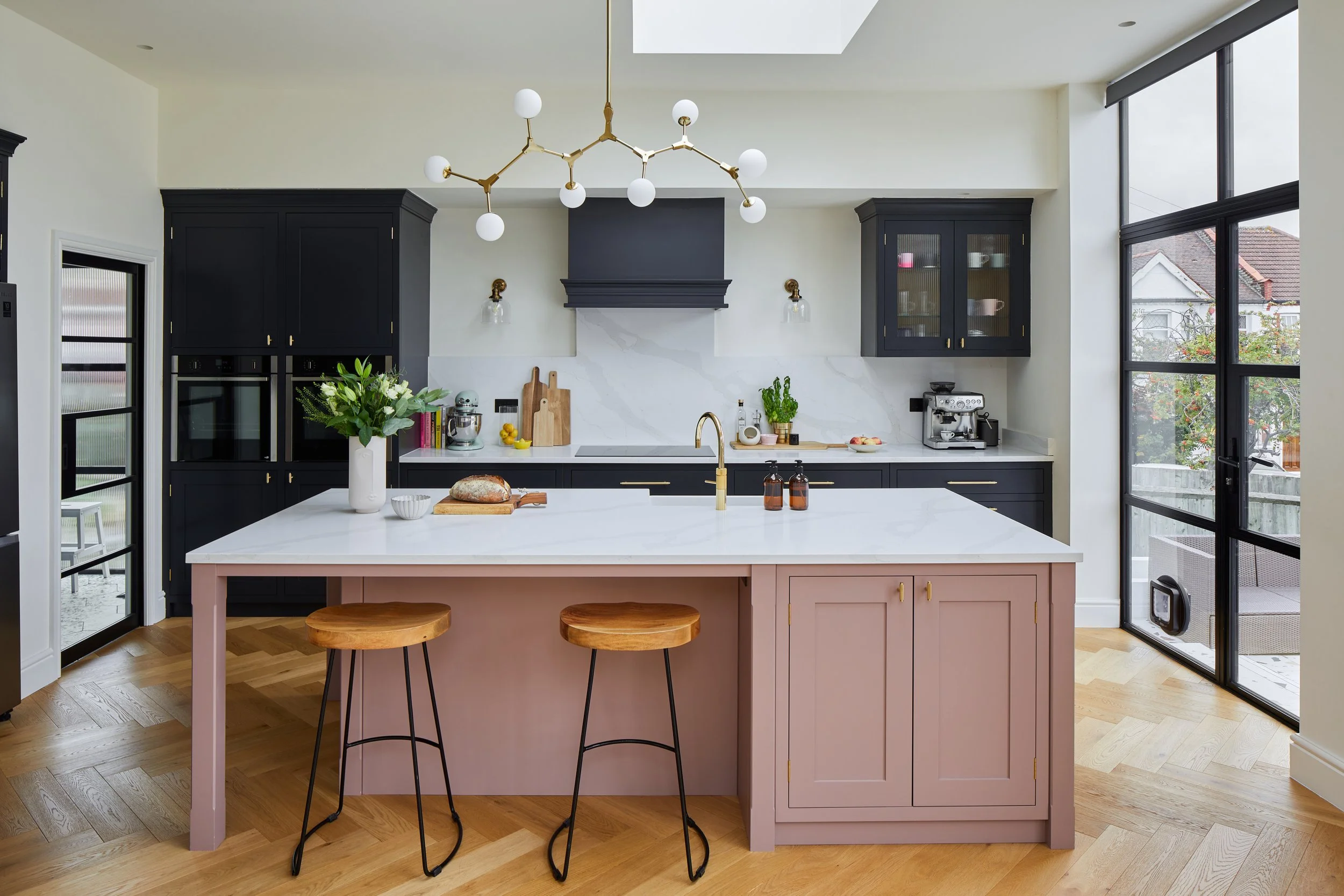
Kitchen Lighting Tips
Brighten Your Cooking Space with These Kitchen Lighting Tips (London edition)
If your kitchen feels a bit gloomy (even after you’ve cleaned the windows and painted the walls), it’s usually not your cabinets—it’s your lighting plan. Most London kitchens I see have either:
- one central ceiling light doing its best, or
- lots of spotlights… placed so you still end up chopping in your own shadow.
Let’s fix that with a simple, designer-friendly approach that works for galley kitchens, terraces, and open-plan kitchen-diners.
Why your kitchen feels dark (even with “bright” bulbs)

Your eyes lie—surfaces tell the truth
A bulb can be “bright” but still leave your worktops dim because brightness needs to land on the surface where you prep.
As a practical target, many guides recommend around 500–700 lux on kitchen worktops for safe, comfortable prep. (Leora Lighting)
(Translation: you want proper task lighting, not just a brighter ceiling light.)
The #1 culprit: shadows from overhead lighting

If the downlight is behind you, your body blocks the light and your hands cast shadows right where you’re working. That’s why under-cabinet lighting is such a game-changer.
The golden rule: layer your lighting (like a designer)
Think of kitchen lighting in 3 layers:
1) Ambient lighting (the overall glow)

This is your “general light” for moving around, cleaning, and day-to-day living. Options:
- recessed downlights
- track lighting
- a ceiling fitting (especially in smaller kitchens)
Designer tip: Ambient lighting should feel even—not “spotty”.
2) Task lighting (the workhorse)

This is the most important layer—lighting that hits:
- worktops
- sink
- hob area
Under-cabinet LED strips are the easiest way to get consistent task lighting right where you need it. Some guides specifically call out ~400 lux at worktops/sink/hob as a useful minimum. (ledrise.eu)
3) Accent lighting (the “this looks expensive” layer)
This adds mood and polish:
- plinth/toe-kick glow (great at night)
- in-cabinet/pantry lighting
- shelf lighting / feature wall wash (perfect for open-plan)
A simple plan that works in almost every London kitchen
Step 1: Start with the prep zones (not the fixtures)
Stand where you prep most and look down. You want light landing on:
- main worktop run
- sink
- island/peninsula (if you have one)
Step 2: Fix shadows first (usually under-cabinet lighting)
If you do one upgrade, do this one.
Real client-style story (typical):
A homeowner in a Victorian terrace had a lovely kitchen… that felt “flat” at night. We added under-cabinet LED strips and suddenly the worktop looked brighter, the splashback tiles popped, and the whole room felt more premium—without touching the cabinetry.
If you want a super quick, rental-friendly version: rechargeable under-cabinet lights can genuinely transform a kitchen for very little money—one popular example was £13.99 for a set of two and was highlighted as a “budget transformation.” (Woman & Home)
Step 3: Add ambient lighting that doesn’t create glare
- If you already have downlights: adjust placement (see below) and consider dimmers
- If you have a concrete ceiling (common in newer flats): track lighting is often easier than chasing ceilings
Step 4: Add one “wow” element (pendants or track)
A kitchen can look instantly more designed with:
- 1–3 pendants over an island/peninsula, or
- a neat track system with adjustable heads
Pendant lights: the height that looks right and works right
The easy guideline
A widely used rule is hanging pendants so the bottom sits about 70–90cm above the worktop. (Niori)
That’s bright enough for the surface, but not so low that it blocks sightlines and conversation.
Spacing (so it doesn’t look awkward)
As a starting point, some guides suggest 70–90cm between pendant centres depending on fitting size and island length. (Social Light)
Light quality: the small details that make it feel “high-end”
Colour temperature (Kelvin) without the jargon

- 3000K (warm white): cosy, flattering, great for kitchen-diners
- 4000K (neutral white): cleaner, crisper for prep (especially in darker kitchens)
Tip: Keep the same temperature within each zone so it doesn’t feel patchy.
CRI: why your food and finishes can look “off”
CRI is colour accuracy. If you’ve ever felt like your paint colour looks different at night, CRI is often the reason.
A common recommendation is CRI 90+ for areas where colour matters (worktops, splashbacks, food). (ledrise.eu)
Placement tips that stop the “spotlight caves” effect
Downlights: don’t put them in a straight line down the middle

If all your downlights run through the centre, you’ll often get:
- bright floor
- darker worktops
- shadows from your body
A better approach is placing lights so they illuminate the front edge of worktops (where you stand), not behind you. (Exact spacing depends on ceiling height and beam angle.)
Under-cabinet strips: go close to the front
Mount strips closer to the cabinet front rail (not right at the wall) so light washes the worktop evenly and reduces shadowing near the edge.
Controls that instantly add comfort (and “designer energy”)
Zone your kitchen lighting
If possible, separate circuits (or smart zones) into:
- Ambient
- Task
- Accent
That lets you do:
- Cooking mode: task + moderate ambient
- Dinner mode: dimmed ambient + accents
- Night mode: plinth / low-level only
UK compliance (quick but important)
In England, electrical work in dwellings is covered by Building Regulations Part P. Official guidance is published by the UK government. (GOV.UK)
If you’re changing layouts, adding circuits, or doing anything that triggers notification requirements, use a properly qualified electrician and keep the right certification.
The IET also outlines how Part P ties into certification/competent person schemes. (IET Electrical)
What does kitchen lighting cost in London? (Realistic guide)
Prices vary depending on ceiling type, access, wiring changes, and finish level. Here are useful planning ranges.
Typical supply costs (UK retail examples)
| Item | Typical supply cost | Notes |
|---|---|---|
| Fire-rated downlights (budget to mid) | from ~£6.98 each and up | Example “from” pricing shown by Toolstation for fire-rated downlights. (Toolstation) |
| Kitchen pendants | ~£50–£325+ each | John Lewis examples include £50 shades and £125–£325 pendants (and higher for designer pieces). (John Lewis & Partners) |
| Track lighting | ~£35+ | Example IKEA 3-spot track is £35. (IKEA) |
| Under-cabinet lighting | ~£22+ per strip (brand-dependent) | IKEA MITTLED worktop strip shown at £22 (60cm). (IKEA) |
| Rechargeable under-cabinet set (renter-friendly) | ~£13.99 | Example highlighted as a budget transformation. (Woman & Home) |
Typical labour costs (London planning range)
Many UK cost guides put London electrician rates around £50–£60/hour (with higher rates for small jobs or emergencies). (Checkatrade)
Example “installed budget” packages (guide only)
- Quick uplift (small kitchen): rechargeable under-cabinet + new bulbs + one feature fitting
- Often: £30–£250 (depending on what you already have)
- Mid-range refresh: 6–10 downlights + under-cabinet strips + dimmer/2 zones
- Often: £900–£2,000
- Premium layered scheme (open-plan): higher-quality fittings + pendants + accents + smart scenes
- Often: £1,800–£4,000+
Lighting upgrades that can help resale appeal
Lighting won’t magically add a fixed number to your home value (property is too complex for guarantees), but it absolutely affects buyer perception, photos, and “wow factor”.
Rightmove has cited research suggesting staged homes can sell for more than non-staged homes (they quote 8%). (Rightmove)
Good lighting is one of the easiest staging wins because it makes rooms feel bigger, cleaner, and more “finished”.
Real-world style example (typical):
A homeowner preparing to sell swapped a single harsh ceiling light for layered lighting (downlights + under-cabinet strips + warm pendants). Their estate agent’s feedback was basically: “It photographs beautifully now,” and the kitchen felt like a selling point instead of “fine”.
Pros and cons (quick, honest take)
Downlights
- Pros: clean look, good ambient coverage, great with dimmers
- Cons: easy to place badly (shadows/glare); can be invasive if ceilings are tricky
Under-cabinet strips
- Pros: best task lighting, makes kitchens feel expensive, helps safety
- Cons: needs tidy drivers/cable routes; cheap strips can hotspot or fail early
Pendants
- Pros: instant style, great zoning over islands
- Cons: wrong height ruins it—aim ~70–90cm above the worktop as a starting point (Niori)
Track lighting
- Pros: flexible aiming, good for awkward layouts and concrete ceilings
- Cons: more visible; can look busy if overdone
Kitchen lighting mistakes to avoid
- “One bright bulb” thinking (it creates shadows)
- Mixing colour temperatures randomly (warm here, cool there = messy)
- No dimming (kitchens feel harsh at night)
- Ignoring CRI (food and finishes look dull) (ledrise.eu)
- Pendant lights hung too low (blocked views) or too high (no task benefit) (Niori)
FAQ
How bright should my kitchen worktops be?
A common target is around 500–700 lux on worktops for prep. (Leora Lighting)
If you’re unsure, add under-cabinet lighting first—it’s the most direct way to increase worktop light.
What colour temperature is best—3000K or 4000K?
- 3000K feels warmer and nicer for open-plan living
- 4000K looks cleaner and more “task-friendly”
A lot of London homeowners do: warm ambient + slightly crisper task lighting.
How high should I hang pendants over an island?
A great starting point is 70–90cm above the worktop (bottom of shade to surface). (Niori)
Do I need fire-rated downlights?
It depends on your ceiling construction and the fitting you’re using. Many UK retailers sell fire-rated options specifically for maintaining fire resistance in certain ceiling types—ask your electrician what’s appropriate for your property. (Toolstation)
Do I need to worry about Part P in a kitchen?
Electrical safety in homes is governed by Part P and the official guidance explains when work is notifiable and how to comply. (GOV.UK)
When in doubt: use a qualified electrician and keep your certificates.