


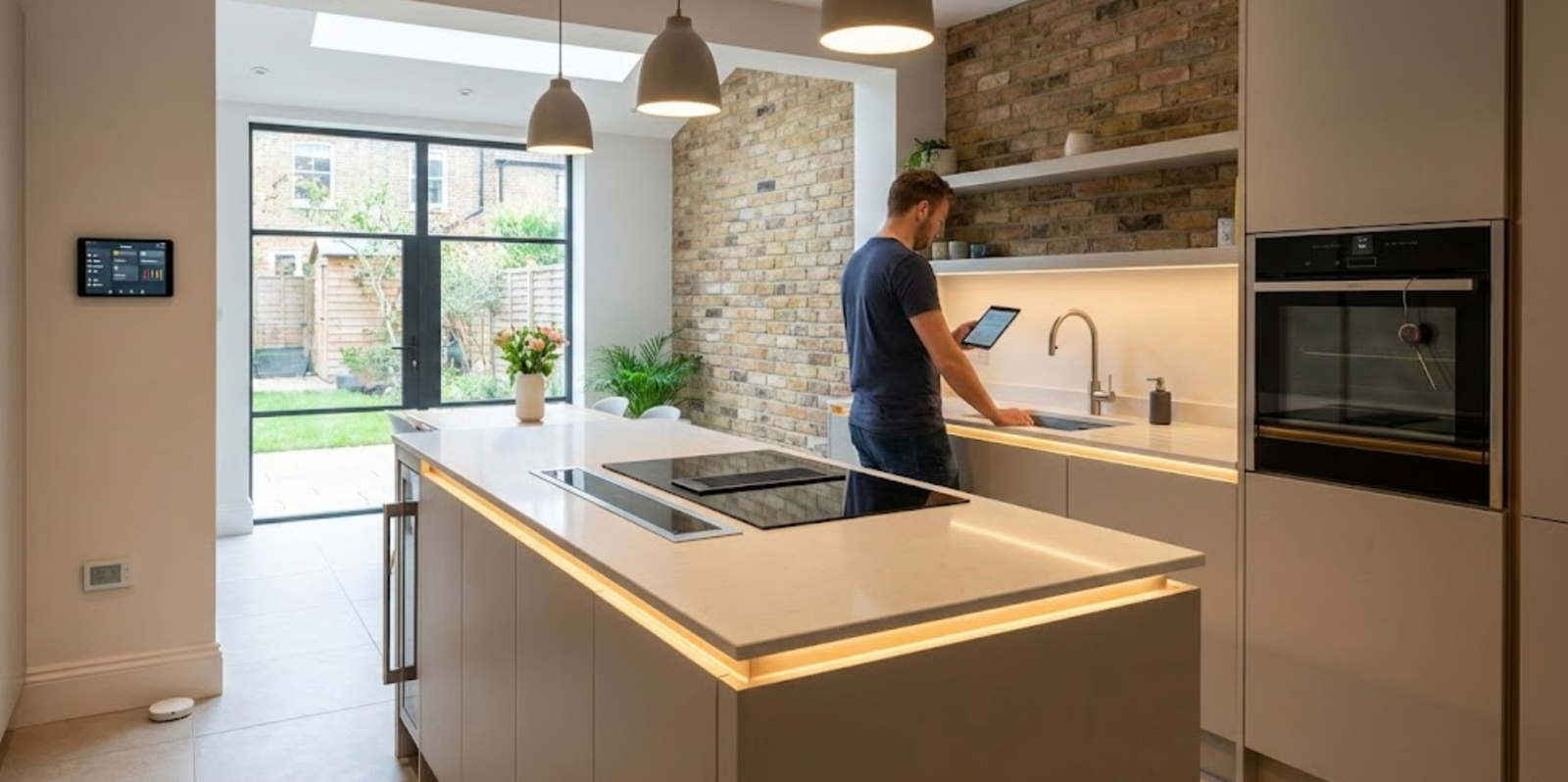
Smart Kitchen Technology
Smart Kitchen Technology: A London Homeowner’s Guide (Without the Gimmicks)
Smart kitchens can be brilliant… or they can be a drawer full of chargers and an app you never open again.
The trick is keeping it simple: use tech to remove friction (time, mess, wasted energy, safety risks), not to turn making pasta into a software update.
This guide breaks down what’s genuinely worth doing in a London home, how much it tends to cost, and the upgrades that can help when it comes time to sell.
What “Smart Kitchen” Actually Means (In Real Life)

A smart kitchen isn’t a giant touchscreen fridge. It’s usually a few invisible improvements that make the space feel calmer and more premium:
- Better cooking control (induction, smart ovens, temperature probes)
- Smarter lighting (scenes, motion in pantry / plinth, softer evenings)
- Safety upgrades (leak detection, shutoff valves, alerts)
- Energy efficiency (zoning, underfloor heating controls, efficient extraction)
- Less clutter (boiling water taps, charging zones, integrated appliances)
And here’s the important bit: a smart kitchen should still work perfectly when the Wi-Fi is having a bad day.
Start With the “Boring” Stuff First (It’s What Makes Everything Feel Premium)
Connectivity: Don’t Build Your Smart Kitchen on Weak Wi-Fi

London homes are famous for thick walls, long layouts, and extensions that murder signal.
- If your router lives in the front lounge and your kitchen is a rear extension, assume you’ll need a mesh system or a hardwired point.
- If you’re buying new devices, look for Matter support where possible—Matter is designed to improve interoperability across ecosystems. (CSA-IOT)
Electrical Planning: The Hidden “Smart Kitchen” Cost

Smart kitchens need more power in better places: pantry, island, appliance housings, and a proper charging zone.
As a budgeting anchor, adding a plug socket point is commonly £100–£200 including labour, depending on positioning. (Checkatrade)
(And yes—this is one of the most common regrets: gorgeous kitchen, nowhere to plug in the coffee machine without trailing leads.)
The Smart Tech That Pays Off Day-to-Day
Smart Ovens: The Best “Busy Household” Upgrade

Smart ovens aren’t magic, but they’re very good at:
- Preheat alerts and timers you won’t miss
- Guided programmes (especially if you cook a lot)
- Remote monitoring (useful with kids, or when you’re juggling work)
A realistic mid-range example for a connected built-in oven can sit around ~£959.99. (Appliance Shop)
Premium end of the market can go far higher—Miele models can run into the £2,000–£4,000+ range depending on spec. (Miele)
Designer tip: If you’ll use one feature forever, it’s a food probe + reliable temperature control.
Induction Hobs: “Smart” Because They Make Kitchens Safer and Cleaner

If you do one modern upgrade in a London kitchen, induction is usually it:
- Faster boil
- Cooler kitchen
- Easy wipe-clean
- Less risk with kids around (no open flame)
Value angle: Induction + good extraction makes open-plan living feel more comfortable—less lingering smell, less heat, less noise.
Venting Hobs: Great for Islands, But Plan Early
Venting hobs are perfect when you’ve got an island and you don’t want a big ceiling hood.
But: they’re not a casual add-on. You’ll need proper planning for ducting/recirculation and cabinetry.
A clear premium pricing example: Miele’s induction hob with integrated vapour extraction is listed at £3,999. (Miele)
Dishwashers That Text You (In the Good Way)

Connected dishwashers are genuinely useful when they:
- Notify when the cycle is done
- Warn about maintenance issues
- Help manage energy-efficient cycles
A Wi-Fi-enabled fully integrated Bosch dishwasher example is shown at £749. (Currys)
Real-life win: If you live in a flat and run it overnight, a quiet model + a simple “done” notification is surprisingly life-improving.
The Upgrades That Feel Luxurious (And Often Add Buyer Appeal)
Boiling Water Taps: The “I Didn’t Think I Needed This” Upgrade

For many London households, boiling water taps become non-negotiable once installed—especially in kitchens with limited counter space.
Quooker lists the Nordic single tap option starting from £1,050. (Quooker)
And the 2025 UK price list shows the CUBE add-on (chilled + sparkling) at £1,150. (Hydroworks)
Practical note: Factor in cartridge/CO₂ running costs if you add chilled/sparkling.
Smart Lighting: The Cheapest Way to Make a Kitchen Feel Expensive
If you want a kitchen to feel “designed,” lighting is where you win:
- Under-cabinet task lights (cooking feels easier)
- Pantry lighting that comes on automatically
- Plinth lights at night (no overhead glare)
- A “dinner” scene that softens the room in seconds
Home value tip: Buyers don’t usually say “I love your smart bulbs.”
They say “this kitchen feels expensive.” Lighting is often why.
Safety Tech: The Most Underrated “Smart Kitchen” Category
Leak Sensors + Shutoff: Small Cost, Big Peace of Mind
This is a smart upgrade that actually matters in London flats (especially if you’re away often).
Even a basic leak sensor under the sink + dishwasher area can catch problems early. (Sinks) (general renovation planning—see contingency approach)
And adding an auto shutoff is the next step for high peace-of-mind households.
Why it adds value: It reduces a buyer’s fear, especially in multi-storey buildings where water damage is everyone’s nightmare.
Energy & Comfort Tech That Can Help Value
Underfloor Heating (with Smart Controls)

Underfloor heating can be a big “premium feel” upgrade in kitchens—especially tiled spaces.
Zoopla’s estate-agent-led research (Jan 13, 2026) suggests underfloor heating can add roughly 1.23% to your asking price in winter listings. (Zoopla)
That’s not a guarantee (no single feature is), but it’s a good sign that comfort features can influence buyer perception.
“Will This Add Value?” What the Data Suggests (And What Buyers Actually Notice)
Open Plan Kitchen-Diner: Still a Big Value Driver

The HomeOwners Alliance published research suggesting that removing an internal wall to create an open-plan kitchen/diner could cost around £3,500 and add £48,000 to the average London property (in their analysis). (HomeOwners Alliance)
That’s a huge claim—and results will vary—but it reflects what London buyers often respond to: light, flow, and a kitchen that feels like the heart of the home.
Smart Home Premium (Buyer Willingness)
Samsung’s Smart Home Buyers Index 2024 reported that survey respondents were willing to pay an average premium of 7.7% for a smart home. (Samsung Global Newsroom)
Important context: this is a brand-led survey, so treat it as a directional signal rather than a valuation rulebook.
The Most Honest Take
Even property professionals will tell you value depends on location, finish level, and the local buyer pool—so speaking to a local estate agent is smart when you’re planning upgrades specifically for resale. (propertymark.co.uk)
“Customer” Experiences (Typical London Scenarios)
These are composite examples based on common London homeowner patterns (details changed; outcomes vary), but they show how people actually feel after the upgrade—and what agents tend to highlight.
1) Victorian terrace, Zone 2: “Open-plan + lighting scenes sold the lifestyle”
They knocked through to create a kitchen-diner, then added:
- induction
- strong extraction
- lighting scenes (cook / dine / night)
Result: The estate agent leaned hard on “open-plan kitchen-diner” in marketing (because buyers respond to it), and the owners felt it lifted the home into the “premium” bracket—very aligned with HOA’s analysis of open-plan impact in London. (HomeOwners Alliance)
2) New-build flat: “Leak detection was the upgrade we didn’t know we needed”
They didn’t want major work, but added:
- leak sensor under sink + dishwasher zone
- smart dishwasher notifications
- simple lighting improvements
Result: Not glamorous, but the owners said it reduced anxiety—especially when travelling. During resale discussions, the agent listed “smart home features” as part of the spec, matching broader market interest in smart-home-ready properties. (Samsung Global Newsroom)
3) Family home: “Underfloor heating made viewings feel ‘high end’”
They upgraded to underfloor heating with smart controls during a refurb.
Result: When they later sold, viewings in colder months felt noticeably more comfortable—exactly the sort of seasonal buyer behaviour Zoopla highlights when it comes to underfloor heating. (Zoopla)
Smart Kitchen Technology Costs (Quick London Budget Anchors)
Here’s a simple pricing snapshot for common upgrades:
| Upgrade | Typical price example / range | Notes |
|---|---|---|
| Add plug socket point | £100–£200 (Checkatrade) | Often the best “hidden” upgrade |
| Connected built-in oven (mid-range example) | ~£959.99 (Appliance Shop) | Look for probe + reliable controls |
| Premium ovens (varies widely) | £2k–£4k+ (Miele) | Worth it if you cook a lot |
| Fully integrated Wi-Fi dishwasher example | £749 (Currys) | Quiet rating + leak protection matters |
| Quooker Nordic (from) | £1,050 (Quooker) | Big convenience + less clutter |
| Quooker CUBE add-on | £1,150 (Hydroworks) | Chilled + sparkling |
| Venting induction hob (premium example) | £3,999 (Miele) | Plan cabinetry + ducting early |
Pros and Cons (The Truth, Not the Sales Pitch)
Pros
- Less daily friction (timers, alerts, automation that saves time)
- Better safety (leaks, heat control, child-friendly cooking)
- “Designed” feel (lighting scenes do a lot)
- Stronger buyer appeal when done cleanly (especially open-plan + comfort) (HomeOwners Alliance)
Cons
- Costs creep if electrical/plumbing aren’t ready
- App fatigue (too many ecosystems = annoying)
- Some devices become outdated faster than cabinetry
- Overcomplication can reduce usability (and buyers hate that)
FAQ: Smart Kitchen Tech for London Homes
Is smart kitchen tech worth it for resale?
It can be—especially when it improves how the kitchen feels (lighting, comfort, open-plan flow). Open-plan kitchen/diner changes, for example, are cited as a strong value driver in London in HOA’s research. (HomeOwners Alliance)
What’s the best “starter” smart upgrade on a tight budget?
Usually: better sockets + better lighting scenes. The kitchen feels more expensive without ripping anything out, and adding a socket point is often a manageable cost. (Checkatrade)
Is Matter important?
If you want flexibility and fewer compatibility headaches, yes—Matter is specifically designed to improve interoperability. (CSA-IOT)
What smart upgrade gives the biggest daily convenience?
Boiling water taps and lighting scenes are up there. Quooker’s Nordic single starts from £1,050, and the CUBE add-on is listed at £1,150 in the 2025 price list. (Quooker)
What’s the most underrated value add?
Comfort and safety. Underfloor heating is one example Zoopla highlights as adding about 1.23% in winter listings. (Zoopla)

Comment (1)
[…] more ideas like these? Read our full guide to Smart Kitchen Technology on […]
Comments are closed.