


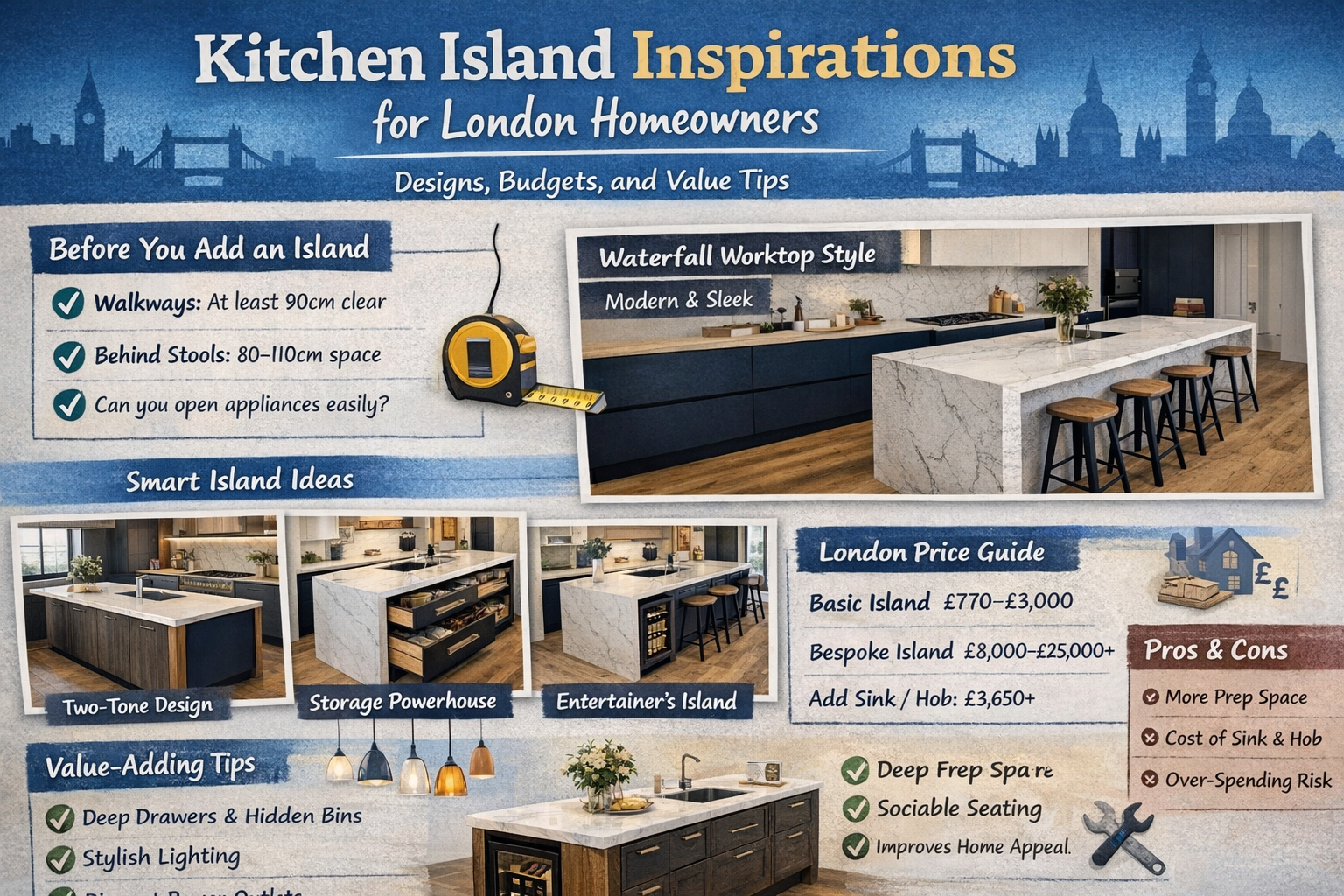
Kitchen Island Inspirations
Intro – Kitchen Island Inspirations
If your kitchen is where everyone ends up anyway, a well-designed island turns that chaos into something that feels intentional: a prep zone, a storage workhorse, and a social “landing pad” all in one.
But (small London kitchens, I’m looking at you) islands can also become the thing you trip over, the place where stools block the dishwasher, or the reason your kitchen suddenly feels smaller.
Let’s make sure yours feels like it was always meant to be there.
Start with the non-negotiable: space and clearances

The quick “will an island work?” checklist
Grab a tape measure and check these first:
- Walkways: aim for at least 914mm (36″) as a bare minimum for comfortable movement.
- Behind seating (stools):
- If no one passes behind seated people, allow 813mm (32″).
- If people need to squeeze past, allow 914mm (36″).
- If people should be able to walk past comfortably, allow 1118mm (44″).
- If two walkways meet at a corner (common in open-plan London kitchen-diners), having one route at 1067mm (42″) helps the space feel less “pinch-pointy.”
If you’re already tight on space, don’t force it. A peninsula or slimline island can give you the same “extra surface + storage” without wrecking the flow.
Decide what your island is for (before you pick how it looks)
This is the part most people skip—and it’s why some islands look gorgeous but annoy you daily.
Pick your primary job
Choose one main purpose, then design around it:
- Prep-first island
Best for busy households. Prioritise uninterrupted worktop, bins, knife storage, and deep drawers. - Hosting / “breakfast club” island
Best for social kitchen-diners. Prioritise seating comfort, leg room, lighting mood, and hidden charging. - Clean-up island (sink + dishwasher)
Best when your perimeter run is limited. Prioritise plumbing practicality, drying zone, and where the dishwasher door lands. - Cooking island (hob)
Best for open-plan sightlines and “chef facing the room.” Prioritise extraction strategy and safety.
Seating comfort matters more than you think
A simple designer trick: plan seating like a dining table, not like an afterthought.
The NKBA guideline also gets specific about knee space per person depending on counter height (helpful if you’re deciding between 30″/36″/42″ seating heights).
12 kitchen island inspirations that work brilliantly in London homes
Here are ideas I use all the time—because they look great and behave well in real spaces.
1) Waterfall worktop (quartz/porcelain) for a clean “architect” look

- Why it works: hides cabinet joins and looks expensive instantly.
- Designer tip: do it on the visible side only if budget is tight.
2) Two-tone island (contrast colour or wood vs painted)

- Great in Victorian terraces where you want the island to feel like furniture, not a block.
3) Fluted or reeded panels for texture

- Adds depth without needing loud colours. Especially good in London flats where light changes throughout the day.
4) Curved ends (the “soften the traffic” island)

- Ideal when your walkway is tight—curves reduce bumping and make the layout feel more fluid.
5) Furniture-style island (legs, framed panels)
- Works beautifully in period homes. Feels intentional, not “dropped in from a showroom.”
6) Storage powerhouse island (double-sided drawers)

- If you cook a lot, this is the one that changes your life: pans, plates, small appliances, recycling—everything disappears.
7) Workstation sink island (if you’re always prepping)
- Add-ons like chopping boards and colanders keep mess contained—but only do it if your plumbing route is sensible.
8) Island with a drinks fridge / “bar zone”
- Perfect for entertaining. It also stops people opening your main fridge 38 times during a dinner party.
9) Island seating that actually feels comfortable

- Think: correct overhang, footrest, lighting that doesn’t glare, and enough space behind stools.
10) Island lighting as the “jewellery”

- Two or three pendants can make the whole kitchen feel styled—just keep them in proportion and not too low.
11) Slimline island (London terrace hero)
- Narrower depth, huge impact. Great for adding storage without killing walkways.
12) Mobile island / butcher’s block (renter-friendly or “test drive”)
- If you’re unsure, trial the lifestyle before building anything permanent.
Real-life client snapshots (anonymised)
These are typical scenarios I see in London—use them as a “does this sound like my home?” check.
Client story: the slim island that saved a small kitchen-diner
A couple in a two-bed terrace wanted an island so badly—but their first sketch left barely a pass-through. We went for a slimline island with drawers on the kitchen side and shallow shelving on the dining side, and kept walkways sensible.
Result: they gained proper prep space and storage without the kitchen feeling tighter. When they later remortgaged, their broker commented that the kitchen presentation and layout felt “high-end and modern,” which helped the owners feel confident about their valuation (not a guarantee—just real feedback you often get when the kitchen is done well).
Client story: “We added seating… and lost our dishwasher”
In an open-plan flat, the owners planned stools exactly where the dishwasher door opened. We shifted the seating zone and gave them a slightly longer overhang. That tiny change stopped daily frustration.
Lesson: islands fail when they ignore how doors and people move—not because the style is wrong.
Client story: the island that helped selling confidence
One homeowner upgraded their kitchen before listing. Their estate agent’s main feedback was that the island created a “social focal point” buyers remember. Value uplift varies a lot, but kitchens are widely seen as a strong buyer trigger—Rightmove even cites Hiscox suggesting a new kitchen or bathroom can add around 5% (context-dependent), and Checkatrade notes new kitchens can add up to ~10% depending on size/quality. (Rightmove)
What does a kitchen island cost in London? (realistic guide)
Prices swing based on size, worktop material, and whether you add plumbing/electrics.
Checkatrade’s UK guide puts:
- Basic island carcass + basic worktop around £770
- Island with electrics, plumbing and sink around £3,650 (ballpark) (Checkatrade)
Labour can be modest for a simple install, but jumps when you add services—MyBuilder notes typical installation can be £200–£500 on average, with higher cost for more complex work (plus typical electrician/plumber hourly ranges). (MyBuilder)
Price table (ballpark ranges)
(London can trend higher than UK averages—always quote locally.)
| Island type | Best for | Typical UK ballpark (supply + install) | Notes |
|---|---|---|---|
| Freestanding / trolley / butcher’s block | Small kitchens, flexibility | £300–£1,200 | Great “trial run” before committing |
| Basic fitted island (storage + worktop) | Most kitchens that can fit it | ~£770–£3,000 | Checkatrade basic island starts around £770 (Checkatrade) |
| Island + electrics/plumbing + sink | Serious cooks, busy families | ~£3,650+ | Useful reference figure (Checkatrade) |
| Premium/bespoke island | Statement homes, design-led projects | £8,000–£25,000+ | Driven by joinery + stone + appliances |
Extra costs people forget
- Boiling water tap can add meaningful cost (Checkatrade’s guide lists this as a notable add-on). (Checkatrade)
- Downdraft extractor / discreet extraction can range from a few hundred to well over £1,000 depending on brand/spec (retailer examples show ~£359 up to ~£1,289+). (AppliancesDirect)
Tips that add value (and make buyers fall a bit in love)
A kitchen island can add value—but the smartest value plays are the ones that also make the space feel effortless.
1) Prioritise storage that hides mess
Deep drawers > cupboards. Add a proper bin/recycling setup. A tidy kitchen photographs better and feels bigger.
2) Keep the island proportionate to the room
Oversized islands can make a kitchen feel cramped (even if it looked cool on Pinterest). If your walkways are tight, go slimmer or choose a peninsula.
3) Add power discreetly
Pop-up sockets, under-worktop sockets, or a hidden charging drawer = modern living. And it’s the kind of detail buyers notice.
4) Lighting = instant “designer finish”
Go layered: ceiling spots for general light + pendants for mood + under-cabinet task lighting.
5) Keep certificates and paperwork
If you change electrics, Part P / Building Regulations compliance matters. Government guidance for Approved Document P is the official reference point, and using a registered electrician makes the paperwork much simpler. (GOV.UK)
Don’t ignore this: electrics, plumbing, and compliance
Electrical work (Part P)
Approved Document P is the official government guidance for electrical safety in dwellings. (GOV.UK)
If your island involves new circuits, changes, or significant alterations, you’ll want the work carried out and certified properly (often easiest via a registered electrician). (Electrical Safety First)
Plumbing for a sink island
It’s not just “add a sink.” You’re routing supply and waste—often under floors—which can affect cost and feasibility. Checkatrade’s island pricing shows how much services can change the budget. (Checkatrade)
Extraction if you put a hob on the island
A ceiling hood, downdraft, or integrated extraction all work—just budget accordingly. Retail pricing examples show downdraft extractors can vary widely. (AppliancesDirect)
Pros and cons (the honest version)
Pros
- More prep space and storage
- Creates a social hub—especially in open-plan layouts
- Can improve buyer appeal when done well (kitchens are a major decision factor for many purchasers) (Checkatrade)
Cons
- Poor clearance planning makes the kitchen feel smaller (stool zones are the common culprit)
- Adding a sink/hob increases complexity and cost (Checkatrade)
- Easy to overspend relative to your property’s “ceiling price” for the street (common in London micro-markets)
FAQ (London homeowner edition)
How much space do I need around a kitchen island?
Use 914mm (36″) minimum walkways as a baseline. For seating, aim for 813mm (32″) behind stools if nobody passes, 914mm (36″) to squeeze past, or 1118mm (44″) to walk past comfortably.
Is an island or peninsula better for a small kitchen?
If your clearances will be tight, a peninsula often wins—it gives you surface + seating without blocking circulation.
What’s a realistic starting budget?
A basic fitted island can start around £770 (UK ballpark), but adding plumbing/electrics quickly moves you into the £3,650+ territory for an island with sink/services. (Checkatrade)
Will a kitchen island add value to my property?
It can—mainly by improving layout, storage, and buyer appeal. Broad guidance varies: Rightmove cites Hiscox suggesting a new kitchen/bathroom can add ~5%, while Checkatrade notes new kitchens can add up to ~10% depending on quality and scope. Treat these as possible outcomes, not guarantees. (Rightmove)
Do I need to worry about Building Regulations for island electrics?
If you’re altering circuits/adding significant electrical work, follow Part P guidance and use a qualified electrician who can certify the work properly. (GOV.UK)