


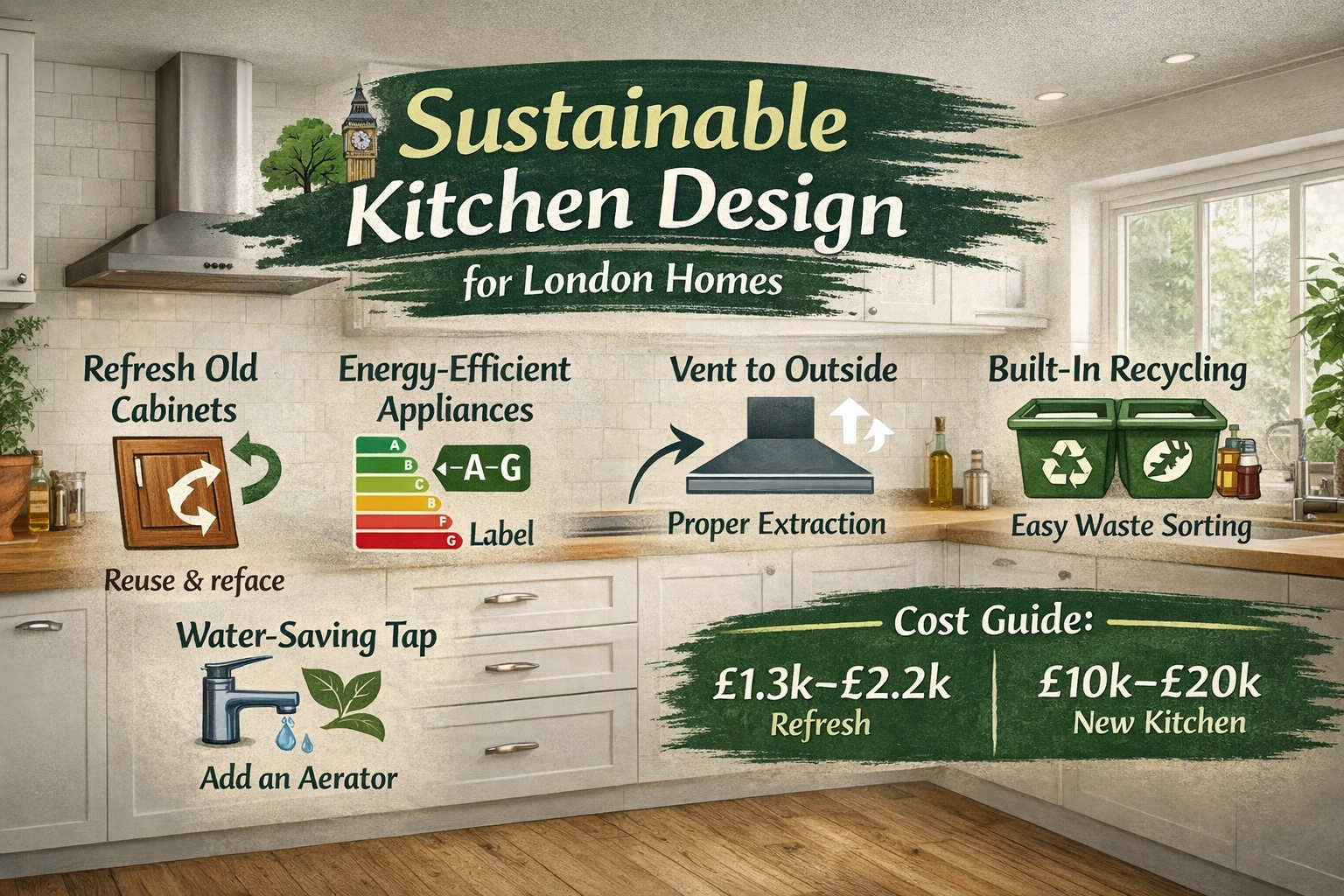
Sustainable Kitchen Design (London Homeowners’ Guide)
Intro – Sustainable Kitchen Design
If you hear “sustainable kitchen” and picture a crunchy, beige, rustic space… good news: that’s not the brief anymore.
A sustainable kitchen in 2026 is basically a kitchen that:
- uses less energy and water
- creates less waste
- keeps indoor air cleaner
- lasts longer (so you’re not ripping it out again in 8–10 years)
And yes—it can still look properly designer.
What “sustainable” actually means in a kitchen
Sustainability isn’t one magic material. It’s a stack of smart decisions:
1) Use what you can (reuse beats “recycle”)

The greenest kitchen is often the one you don’t rip out. Keeping solid cabinet carcasses, retaining a workable layout, and upgrading the visible/functional parts can dramatically cut waste.
2) Cut running costs (energy + water)
Energy labels and efficient choices genuinely add up over time. The UK energy label scale runs A to G, and picking higher-rated appliances can reduce lifetime running costs. – Energy Saving Trust
3) Improve indoor air quality (huge in open-plan London homes)
Cooking creates moisture, odours, NO₂, and fine particles—so ventilation is not optional. In England, Approved Document F sets minimum kitchen extract rates: 30 l/s if your cooker hood extracts to outside, or 60 l/s if there’s no hood extracting to outside (or it doesn’t vent out). It also explicitly notes a recirculating hood on its own doesn’t comply. – GOV.UK
4) Choose materials that last (and are credibly sourced)
Longevity is sustainability. A kitchen that still looks great after years of real life beats a “green” kitchen that chips, peels, swells, and gets replaced early.
The sustainability move that saves the most money: “keep the bones”
Before you choose a worktop colour, ask one question:
Can we keep the cabinet carcasses and the layout?
If your carcasses are sturdy and your layout basically works, you can often do a reface + upgrade approach:
- new doors/drawer fronts
- new handles
- new hinges/runners (soft-close feels like a whole new kitchen)
- new worktop + splashback
- better lighting + extractor
It’s one of the most cost-effective ways to reduce waste and get a major visual transformation. (And it’s far less disruptive—especially in flats.)
Typical cost guide (UK): replacing kitchen doors is often around £1,300–£2,250 total on average (depending on number/quality). – Checkatrade
Layout choices that are quietly “eco” (and make daily life better)
Sustainable design isn’t just materials. It’s also how the kitchen functions.
Keep services in place when possible
Moving sinks/hobs can trigger extra plumbing/electrics and building work—more cost, more waste. If you can keep the “wet wall” and the cooking zone roughly where they are, you usually get a greener (and cheaper) project.
Design to reduce “stuff”
This sounds small, but it’s real: a kitchen with the right storage means fewer duplicate gadgets, fewer impulse buys, and less clutter.
High-impact storage upgrades
- deep drawers instead of cupboards for pans
- a proper pantry section (even a 300mm pull-out can be life-changing)
- a hidden recycling + food waste pull-out (so it actually gets used)
Cabinets and timber: how to avoid greenwashing

If you’re buying new cabinetry, look beyond the showroom talk.
Ask for credible timber sourcing (FSC + chain of custody)
FSC chain-of-custody is designed to verify forest-based materials through the supply chain—helpful if you’re trying to avoid “trust me” sourcing. – Forest Stewardship Council
Aim for durability first
- solid hinges/runners
- moisture-resistant carcasses if you’re prone to spills
- finishes that can be cleaned without babying them
Go lower-emission where you can
Low-odour / low-VOC paints and finishes can make the home feel noticeably nicer right after a renovation (especially if the kitchen is open to living areas). UK government publications discuss VOCs and indoor air considerations, even while noting gaps in UK indoor guideline coverage for individual VOCs. – GOV.UK
Worktops and surfaces: pick “long life” over “perfect on Instagram”

There’s no single “best” sustainable worktop. What matters most is:
- How long it lasts
- How repairable it is
- Whether you’ll still like it in 10 years
A practical way to choose
Ask yourself:
- Will I mind scratches/patina?
- Do I want “wipe-and-go”?
- Do I want heat resistance?
- Do I want something I can refinish (like some woods)?
In London, the most sustainable choice is often the one that prevents a “we’re redoing it again” moment.
Appliances: use the energy label like a designer (not a salesperson)

Appliances are one of the easiest ways to reduce running costs long-term.
What to do in real life
- Compare like-for-like models using the A–G label and the per-year or per-100-cycles figures (varies by product category). – Energy Saving Trust
- Prioritise efficiency where it runs constantly: fridge/freezer first.
Dishwasher vs handwashing (yes, a dishwasher can be greener)
If you’re still doing the “I’ll just wash by hand to save water” thing—modern testing suggests dishwashers can use far less water than sink washing. Which? found dishwashers on average used almost 80% less water per full wash than washing up by hand. – Which?
Induction vs gas: sustainability + indoor air in one decision
This is where “sustainable” gets very practical.
Cooking on gas can raise indoor pollution (NO₂ and fine particles), and pollutants can spread through homes and linger—especially without strong extraction. UK reporting on tests comparing gas and induction highlighted how high indoor pollution can get during gas cooking. – The Guardian
You don’t have to panic—just design properly:
- choose induction if it suits your cooking style
- either way, invest in real ventilation (next section)
Ventilation: the most underrated “sustainable kitchen” feature

If you only upgrade one thing for sustainability and comfort, make it ventilation.
The London-friendly rule
Duct to outside if you possibly can.
Approved Document F (England) lists these minimum kitchen extract rates for intermittent systems:
- 30 l/s: cooker hood extracting to outside
- 60 l/s: no cooker hood, or hood does not extract to outside
And it warns that a recirculating hood alone doesn’t meet Part F ventilation compliance. – GOV.UK
Design tips that actually matter
- keep duct runs short and as straight as possible
- avoid cheap flimsy ducting (it can be noisy and restrictive)
- pick a quieter hood so you’ll actually use it
Water savings that don’t feel “low flow”
Tap aerators: tiny upgrade, big payoff
A kitchen tap aerator can reduce water flow without ruining the rinse. Energy Saving Trust notes aerators can help you save up to 5,000 litres of water a year. – Energy Saving Trust
Waterwise also points out low-cost tap aerators can save households money on annual water/energy bills. – Waterwise
Waste and “circular” design: less landfill, fewer regrets
Sustainable design is basically circular economy thinking applied to your home: eliminate waste, circulate materials, regenerate nature. – Ellen MacArthur Foundation
Easy circular wins in a kitchen
- choose replaceable parts (doors, handles, end panels)
- add proper recycling + food waste pull-outs
- donate or sell usable old units/appliances rather than binning them (local reuse groups, charities, resale platforms)
WRAP’s work on circular living focuses on reducing waste and carbon through design and reuse approaches. – WRAP
What does a sustainable kitchen cost in London?
Prices vary wildly by size, access (flats!), finishes, and whether you’re moving services. These are useful ballpark UK ranges:
| Project type | What it usually includes | Typical UK cost range |
|---|---|---|
| Door replacement / facelift | new doors + hardware (often keeps carcasses) | ~£1,300–£2,250 average total Checkatrade |
| Kitchen fitting (labour only) | removal + install (excluding supply) | £2,000–£6,000 (avg ~£3,500) Checkatrade |
| Mid-range new kitchen | supply + design level varies | £10,000–£20,000 Homebuilding |
| Full range (budget → high-end) | depends heavily on spec | £500–£1,000 (budget) to £25,000–£50,000 (high-end) screwfix.com |
London note: access constraints, parking, carry distance, permits, and building rules can push labour/installation up—especially in conversions and flats.
“Will this add value to my home?” (What actually moves the needle)
A kitchen can add value in two ways:
- harder value (efficiency and performance signals)
- buyer emotion (it feels modern, clean, and low-hassle)
Energy performance can correlate with sale price
Research reviews of EPC and pricing often find a sale-price premium for more efficient homes—commonly in the ballpark of ~1–3% per EPC band in many studies. – ScienceDirect
A kitchen renovation alone doesn’t necessarily change your EPC, but these choices help your “efficient home” story:
- efficient appliances
- strong extraction
- LED lighting
- water-saving fixtures
Value-adding tips buyers notice immediately
- quiet, effective extractor (no lingering smells in open-plan)
- clutter-free worktops thanks to smart storage
- integrated bins and recycling
- good lighting (task + ambient)
- durable worktops that still look fresh
Real-world client experiences (composite examples from typical London projects)
These are composites based on common outcomes I see in London renovations—meant to show how the decisions play out in real life.
1) “We kept the carcasses and it felt like a brand-new kitchen”
A couple in a Victorian terrace kept their cabinet boxes, swapped to new shaker doors, upgraded hinges, added LED under-cabinet lighting, and installed a ducted extractor. Their feedback: the kitchen felt “high-end” without the cost and disruption of a full rip-out. When they sold later, their agent’s comment was basically: “This looks modern, it presents cleanly, and it doesn’t scare buyers with ‘work needed.’”
2) “Induction + proper ventilation fixed the open-plan smell problem”
A Docklands flat owner said cooking smells used to drift into soft furnishings for days. They moved to induction and upgraded to extraction that actually vents outside. Result: less lingering odour, less condensation, and the flat felt “fresher” day-to-day—especially during winter when windows are rarely open.
3) “Water and storage upgrades were the surprise favourites”
A family in North London expected the worktop to be their favourite change. Instead, they loved the boring stuff: a tap aerator (still strong rinse), a pull-out recycling unit, and a better pantry setup. Their kitchen stayed tidier, and they felt like the space worked better with less effort.
Pros and Cons of sustainable kitchen design
Pros
- Lower running costs from efficient choices and better habits – Energy Saving Trust
- Improved indoor air comfort (especially with proper extraction) – GOV.UK
- Less waste and disruption when you reuse/reface – Ellen MacArthur Foundation
- Stronger buyer appeal when the kitchen feels modern, clean, and efficient – ScienceDirect
Cons
- Best options (quiet extraction, durable finishes) can cost more upfront
- “Eco” claims can be vague—sourcing and specs matter (ask for certification) – Forest Stewardship Council
- Some natural materials need maintenance
- Induction can require cookware changes (not always, but sometimes)
Quick Sustainable Kitchen Checklist
- ✅ Can we keep the layout and/or cabinet carcasses?
- ✅ Ducted extractor to outside (aim for Part F intent) – GOV.UK
- ✅ Efficient appliances using the A–G label – Energy Saving Trust
- ✅ LED lighting + zoned switching
- ✅ Tap aerator / water-saving fixtures – Energy Saving Trust
- ✅ Recycling + food waste storage that’s genuinely convenient
- ✅ Credible sourcing for timber (FSC chain of custody) – Forest Stewardship Council
FAQ
Do sustainable kitchens always cost more?
Not if you reuse what’s already good. Refacing + targeted upgrades can deliver the “new kitchen feeling” with less waste and spend. – Checkatrade
Do I really need a hood that vents outside?
If you can, yes. UK guidance sets minimum extract rates and warns recirculating-only hoods don’t meet ventilation compliance on their own. – GOV.UK
Is induction actually better than gas?
It can be better for indoor air, and it’s future-friendly. Gas cooking can raise indoor pollution, especially without strong ventilation. – The Guardian
Do dishwashers save water?
Testing suggests they often do—Which? found dishwashers used almost 80% less water per full wash than handwashing. – Which?
Will this add value to my London home?
A great kitchen improves saleability. Broader research often links better energy performance (EPC) with sale price premiums, though your kitchen choices are usually one part of that bigger story. – ScienceDirect