


This One Kitchen Backsplash Idea Will Blow Your Mind!
Intro—The number one trending kitchen backsplash idea homeowners are using for a designer finish.

If you’ve ever looked at a “wow” kitchen and thought, Why does this look so expensive?… it’s usually not just the cabinets. It’s the backdrop.
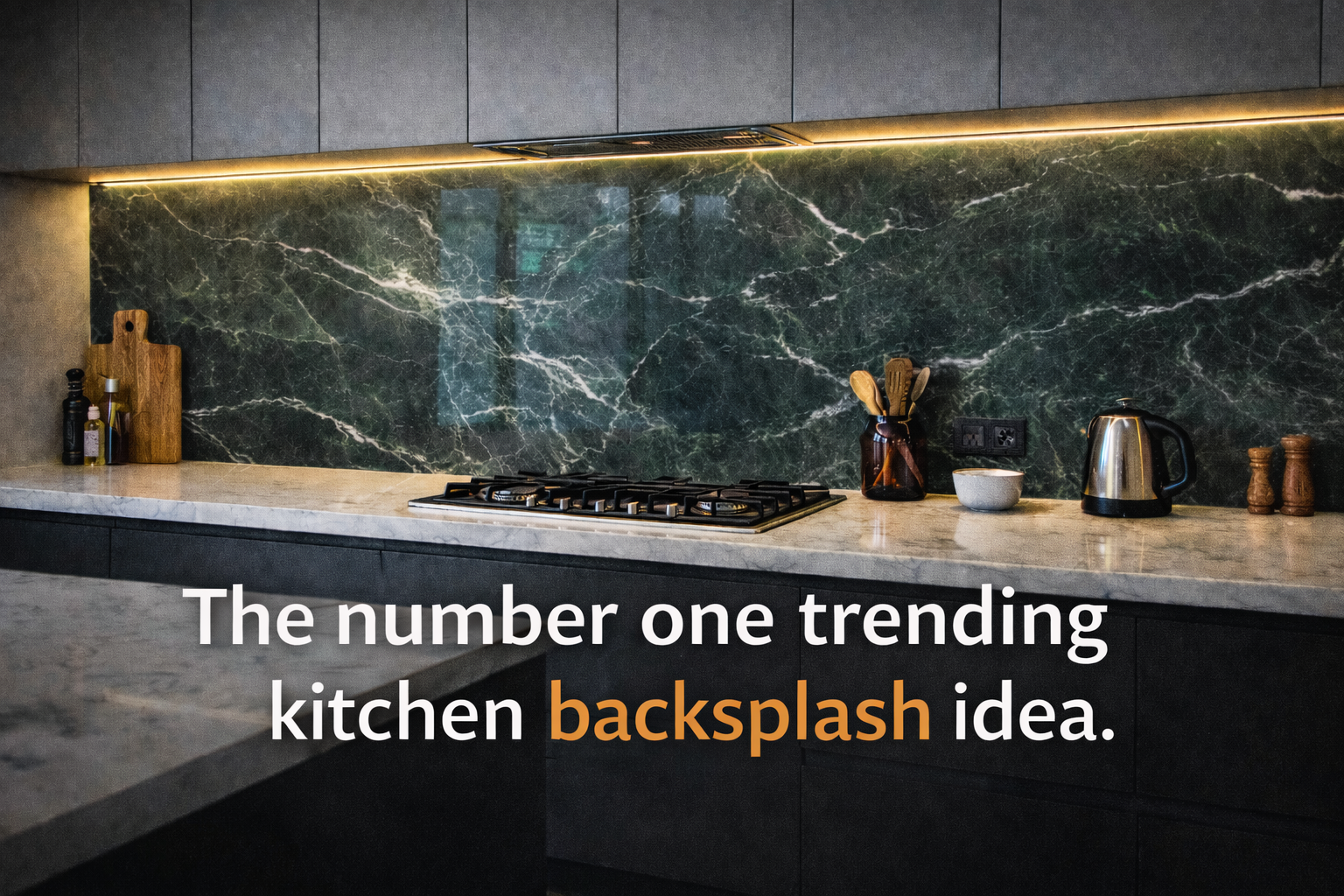
The “blow-your-mind” idea: a seamless, full-height slab splashback

The idea is simple: instead of lots of little tiles and grout lines, you use one (or a few) large-format panels—often porcelain or sintered stone—running worktop to wall units (or even ceiling). Fewer joins = calmer, cleaner, and more “architect-designed.”
Why this works especially well in London kitchens

- Small spaces look bigger when the wall reads as one continuous surface.
- Less visual clutter helps period homes feel fresh without fighting the original character.
- Easier cleaning: grout is often the part that discolours first; grout-free/low-joint splashback options are widely positioned as easier to keep hygienic.
What it looks like in real life (and why people obsess over it)



Imagine a marble-look Calacatta slab behind your hob with the veining flowing cleanly across—no grid of grout lines. It photographs like a showroom, even if the kitchen is “normal” everywhere else.
The designer moves that make it look high-end, not “big tile on a wall”
- Go full-height where it matters: behind the hob and sink run.
- Keep sockets tidy: fewer, better placed, aligned.
- Light it properly: a continuous under-cab LED makes the surface glow (and hides day-to-day splashes).
Materials that nail the slab look (without regrets later)
Porcelain (large-format / slab look)

- Very popular because it’s hard-wearing and can mimic stone beautifully.
- Porcelain tiles are typically dense/non-porous—often no sealing needed on the tile, though grout may benefit from sealing.
Sintered stone (ultra-compact surfaces)



- Built for heat, stains, busy kitchens.
- UK pricing guides often quote ~£250–£1,000 per m², with many placing the “average” around £500–£600 per m².
Dekton-style surfaces

- Often positioned as luxury; some UK suppliers note Dekton starts around ~£600 per m². (Stone Tile Company)
- Other UK guides quote broad “typical” ranges (varies by colour/finish/cut-outs). (The Marble Store)
Glass (the sleek “no grout” alternative)

- Super clean look, easy wipe down, and very hygienic due to being non-porous.
Zellige / handmade-look tile (if you want texture + soul)

- Gorgeous, imperfect, light-catching—but more grout lines and more variation.
- Example UK retail pricing ranges from ~£55/m² to ~£100–£190+/m² depending on supplier/style.
Price guide for London homeowners (ballpark, but useful)
Here’s the honest truth: splashbacks are small areas, so you’ll often hit minimum day rates and “cut-out pricing” for sockets.
Tiling benchmarks are fairly well documented:
- Average kitchen wall tiling is often quoted around £110 per m² including standard tiles, materials, and labour.
- Labour-only is commonly quoted around £30–£60 per m², with day rates often ~£150–£350+ (London can run higher).
Typical costs table (London ranges)
| Option | Typical supply cost | Typical installed cost (London-ish) | Notes |
|---|---|---|---|
| Standard wall tile splashback | Varies | £80–£130/m² | Small jobs may be priced per job, not per m² |
| Zellige / handmade-look tile | ~£55–£190+/m² | Often higher labour | Stunning texture, more maintenance |
| Glass splashback | Often ~£240–£300/m² (Mayfair Worktops) | Install often ~£48–£120/m² (Chaboun Construction Limited) | Grout-free, easy wipe |
| Porcelain slab / slab-look | Worktop pricing often ~£250–£450/m² | Fabrication + cut-outs can push higher | Needs flatter walls |
| Sintered stone / Dekton-style | ~£250–£1,000/m² | Often premium installed totals | Luxury + durability |
Quick “adds value” mindset (before we get into the fun stuff)
A backsplash alone won’t “break the postcode ceiling”—but it can make a kitchen feel newer and photograph better, which helps with buyer confidence.
As a rough benchmark, some UK guidance suggests a new kitchen can add around 4–5% to a property’s value (varies by area and spec).
Pros of the slab splashback idea
- Looks premium immediately (less visual noise)
- Easier wipe-down day to day (minimal grout)
- Brilliant in small kitchens (makes walls “recede”)
- Great for resale photos
Cons (so you don’t get surprised later)
- Higher upfront cost than standard tiles
- Walls need to be flatter
- Socket cut-outs must be planned early
- Repairs can be trickier than swapping tiles
A quick client-style story (typical London scenario)
A Victorian terrace kitchen had decent cabinets but dated mosaic tiles. We swapped to a slab-look porcelain backsplash + continuous under-cab lighting.
Their agent didn’t promise a specific uplift number (they rarely do), but they did comment that it made the kitchen feel “new-build clean” in photos—which can help you hit the top end of buyer interest for your street.
A renovation story where value uplift was discussed openly
A widely shared renovation story described how improved layout/design (including a redesigned kitchen) was credited as a key part of a larger uplift in value—showing how powerful kitchens are in buyer perception when the whole scheme is executed well.
The three decisions that determine how expensive it will look
- Height (splash zone vs full-height)
- Join strategy (one panel vs multiple)
- Cut-outs (sockets, switches, extractor)
Height options that work in real London homes
- Between worktop + wall units (best balance of cost and impact)
- Full-height behind the hob only (feature wall vibe without full spend)
- Full-height everywhere (maximum calm, maximum wow)
The undertone trick that avoids the “why does this feel off?” problem
Pick your backsplash undertone based on your worktop:
- Warm worktop? Avoid icy whites.
- Cool/grey worktop? Avoid creamy yellows.
Lighting: the cheapest upgrade that makes the backsplash look twice as good
A continuous LED strip under wall units is the difference between “nice material” and “wow material”.
Measure like a designer (so your quote is accurate)
- Measure total linear runs
- Confirm height (to wall units or ceiling)
- Mark every socket/switch
- Note hob type and extractor style
Wall prep: the hidden step that makes or breaks slab splashbacks
Large panels show every bump. In older London properties, walls are often bowed or patched, so a good installer may recommend skimming or boarding in key zones.
Sockets without ruining the view (and without annoying daily use)
- Keep sockets in a straight line
- Group them where possible
- Consider under-cab socket rails or pop-ups on islands
Fabrication & installation: what happens on fit day
Typically: template → workshop cut/polish → dry fit → install → finish edges and seals.
Cut-outs add cost—expect it.
Finishing details that separate “good” from “wow”
- Clean silicone lines
- Neat corners
- Tight alignment to worktops
- No chips around sockets
- Consistent grout (if tiled)
Cleaning & maintenance (simple routines that keep it looking new)
- Daily: microfibre + mild detergent
- Weekly: degrease near the hob
- Avoid abrasives on polished finishes
- If tiled, grout is the weak point—sealing can help.
Heat and hob safety: choose the right material in the right place
Busy hob zones usually benefit from tougher, heat-friendly materials (one reason people choose sintered/compact surfaces).
The mistakes that make a backsplash look cheap (even if it wasn’t)
- High-contrast grout you can’t keep clean
- Random socket placement
- No under-cab lighting
- Overly busy pattern in a small kitchen
- Poor edge finishing
Will this add property value, or just look nice?
A backsplash upgrade won’t magically add a fixed % on its own—but it can reduce buyer objections and lift perceived quality.
Zooming out, some UK sources suggest a new kitchen can add ~4–5% value depending on spec and area.
And Zoopla notes typical kitchen renovation budgets can land around £20k–£30k, which helps you sanity-check spend for your neighbourhood.
FAQ
Is a slab splashback worth it in a small London kitchen?
Usually yes—small spaces benefit most from the “one calm surface” effect.
Is glass more practical than tiles?
Glass is often chosen because it’s non-porous and grout-free, so it’s very easy to wipe down. (Chaboun Construction Limited)
What’s the most cost-effective “designer look”?
Large-format porcelain tiles + simple layout + great lighting can mimic the slab vibe for less.
Does porcelain need sealing?
Porcelain tiles generally don’t, but grout may benefit depending on type and location.
How do I stop grout looking dirty?
Avoid tiny mosaics behind the hob, pick a mid-tone grout, and seal if appropriate.