


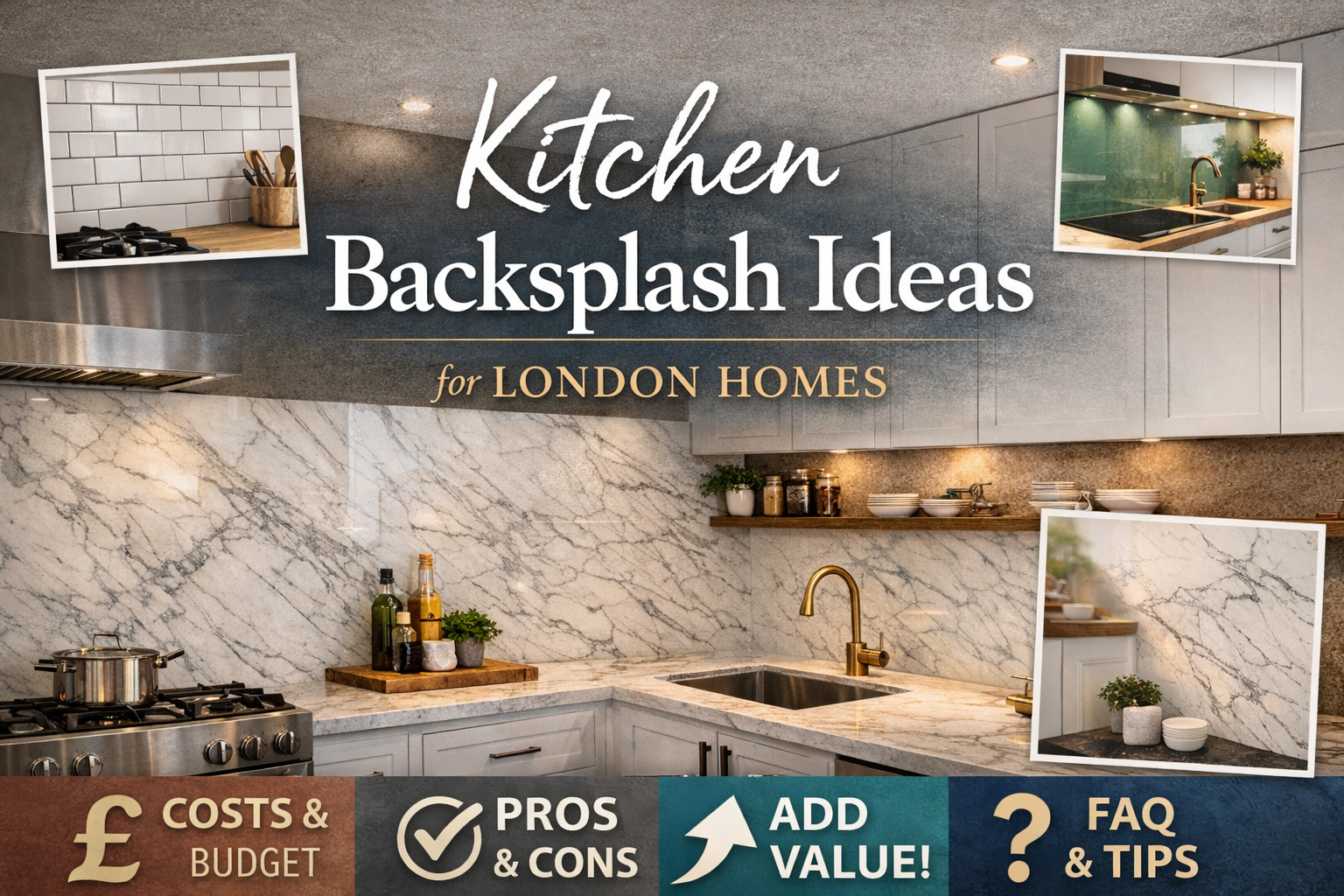
Kitchen Backsplash Ideas (Splashbacks) for London Homes
Intro – Kitchen Backsplash Ideas

A good splashback is one of those “small” decisions that makes a kitchen feel finished. It’s also one of the easiest ways to modernise a London kitchen without ripping everything out—especially if your layout is staying put.
Below is a designer-style guide (but in plain English): ideas, materials, what they cost, what’s worth it for resale, and the stuff people only learn after they’ve cleaned grout for six months.
Choose your splashback in 60 seconds
1) Where is it going?
- Behind a hob (heat zone): prioritise heat resistance and fewer weak points.
- Behind a sink (wet zone): prioritise water resistance and easy cleaning.
2) How “low maintenance” do you want it?
- Lots of grout lines (small tiles): looks great, more upkeep.
- Fewer joints (large-format tiles / panels / slabs): calmer look, easier wipe-down.
3) What vibe are you after?
- Classic London (metro/subway tile)
- Modern (stacked tile, big porcelain, glass)
- High-end (slab backsplash that matches the worktop)—this is a big 2026 trend, partly because there’s no grout to scrub. (Real Simple)
12 backsplash ideas that look designer (even in small London kitchens)
1) Classic white metro tile (but make it sharper)


- Keep the tile classic, then upgrade the “details”: slim trims, neat edges, and a grout colour that won’t ruin the look.
- A simple metro layout is still popular because it’s adaptable and easy to clean. (Tile Warehouse)
Style tip: Use a slightly warmer white tile with warm worktops (oak, beige stone) so it doesn’t feel clinical.
2) Vertical stacked metro tile (instant modern)
Same metro tile… but stacked vertically instead of brick bond. It reads taller and cleaner—great for London flats where you want the kitchen to feel less “busy.”
3) Herringbone metro (more “bespoke” without buying expensive materials)

Herringbone looks premium because the labour is more involved, not because the tile has to be fancy.
Reality check: labour tends to go up because it’s slower to set out and cut (more on costs below). UK tiling averages are often quoted around ~£110/m² (materials + labour) as a starting point. (Checkatrade)
4) “KitKat” / finger mosaics (texture that looks expensive under lighting)

These slim tiles are basically made for under-cabinet lighting. They create a gentle shadow pattern that makes a basic kitchen feel upgraded.
Best in: neutral colours (stone, warm white, sage) so it doesn’t overwhelm a small space.
5) Large-format porcelain tile (the calmest look for busy cooks)

Fewer grout lines = less maintenance and a more seamless look. If your kitchen gets heavy use, this is one of the most practical “designer” picks.
6) Full-height splashback to cabinets (the “it’s finished” look)
A lot of homeowners now take the splashback higher—up to cabinets or around the hood—because it looks intentional and protects more wall area. A Houzz study reported that full coverage to cabinets/range hoods is common, with a smaller but growing share going all the way to the ceiling. (Houzz Blog)
7) Slab backsplash (worktop material up the wall)

If you want the most “high-end” look, this is it: the worktop material continues vertically for a single, uninterrupted surface.
Why it’s trending:
- Designers like the seamless, sculptural look and the fact there’s no grout staining. (Real Simple)
- Houzz’s 2026 trends coverage notes slab backsplashes are growing as a choice among renovating homeowners. (Real Simple)
Heads-up: natural stone can need sealing and can etch or stain if neglected (porcelain slab or quartz can be lower-fuss alternatives). (Real Simple)
8) Coloured glass panel (sleek, hygienic, easy wipe)

Glass gives you a totally grout-free surface and can look amazing in compact kitchens because it reflects light.
Safety note: If you’re fitting behind a gas hob, suppliers commonly specify a minimum clearance (examples vary by supplier guidance). Always follow your chosen manufacturer’s rules for your exact hob/splashback. (Splashbacks)
9) Stainless steel (chef-y, tough, surprisingly modern)

This is brilliant behind a hob if you cook a lot—heat friendly, wipes clean fast, and looks intentional if you match it with minimal hardware.
10) Warm metal accents (copper/brass vibes)
Some design guides push metal alternatives partly for hygiene and easy cleaning compared with grout-heavy tile. (Ideal Home)
You don’t have to do the whole wall—sometimes a metal panel behind the hob plus simpler tile elsewhere looks best.
11) Soft-colour splashback (the “London shaker kitchen” trick)

A pale blush, warm beige, or gentle sage splashback can make a shaker kitchen feel fresh without going trendy-for-the-sake-of-it. Houzz project examples often show how colour splashbacks add warmth and personality. (Houzz)
12) Budget-friendly wall panels (laminate / acrylic / composites)

If you want the fastest upgrade with minimal mess, panels can be the quickest route (especially if the kitchen is in use).
Important heat rule: some panel types aren’t suitable behind certain hobs (e.g., some guides advise against acrylic/composite panels behind gas/electric hobs, and give minimum gaps for induction). (Cut My)
Will a splashback add value to your home?
A splashback alone usually won’t add a neat “£X” to your valuation—but it can absolutely help the kitchen present like a higher tier, which matters a lot in London where buyers judge quickly.
What’s backed by evidence:
- HomeOwners Alliance research (with builders and estate agents) suggests even budget kitchen makeovers can add meaningful value in London—e.g., they cite around £4,000 for upgrades (like worktops/cabinet doors/flooring) potentially adding ~£17,000 in value to a London property. (HomeOwners Alliance)
- Bigger layout changes can move the needle even more (they cite open-plan changes as particularly value-adding). (HomeOwners Alliance)
How the splashback fits in (practical takeaway): if you’re doing a “refresh not remodel,” the splashback is one of the most visible upgrades you can make—so it helps your kitchen look updated within a sensible budget (that’s the value play).
Real homeowner stories (value lift after transformation)
These aren’t “backsplash-only” stories—but they show what buyers respond to: a more functional, updated kitchen.
- The Guardian profiled homeowners who bought a dated fixer-upper and renovated over time; their home value reportedly rose substantially after works (including major updates), showing how targeted improvements can transform market perception. (The Guardian)
- The Times highlighted a redesign-led renovation where the home’s value increased significantly, with the kitchen redesign called out as a key feature—an example of how a well-executed kitchen can anchor the whole property’s appeal. (The Times)
Costs in London: what to budget (with a realistic table)
Prices vary by layout, wall condition, number of cut-outs (sockets!), and whether you’re doing hob-only or full runs. These ranges are typical “starting points” from UK pricing guides and retailers:
| Splashback type | Typical cost range (materials + fitting, ballpark) | Notes |
|---|---|---|
| Tiled splashback (ceramic/porcelain) | ~£80–£150+/m² | UK average tiling cost often cited around ~£110/m² as a benchmark; labour-only commonly ~£20–£40/m². (Checkatrade) |
| Metro tile materials (example pricing) | ~£15–£35/m²+ | Example retail pricing is often in this zone depending on range/finish. (Wickes) |
| Glass splashback (made-to-measure) | ~£240–£600+/m² | UK pricing guides often break this into entry/mid/premium bands. (CreoGlass®) |
| Professional splashback install (generic guide) | ~£100–£1,000 total | Depends on size/complexity; useful as a “sanity check.” (DIY Splashbacks) |
London reality: if your walls are wonky (hello, Victorian terraces), prep work can add cost—but it’s what makes the finish look expensive. Read our Tiler Prices article for more tiling pricing details.
Pros and cons (quick, honest version)
Tiles (ceramic/porcelain)
Pros: huge design choice, easy to repair a small area, classic. (Tile Warehouse)
Cons: grout maintenance; lots of cuts around sockets can look messy if rushed.
Large-format porcelain
Pros: fewer grout lines, sleek look, practical.
Cons: needs careful handling and very flat walls for the best finish.
Glass
Pros: grout-free, hygienic, modern, easy wipe-down. (Ideal Home)
Cons: needs accurate templating; clearances matter behind hobs. (Splashbacks)
Slab (stone/quartz/porcelain slab)
Pros: premium, seamless, very “2026 kitchen” right now; no grout staining. (Real Simple)
Cons: higher cost; some natural stone needs sealing and can etch/stain if neglected. (Real Simple)
Metal (stainless/copper/brass)
Pros: great behind hobs, easy cleaning, durable. (Ideal Home)
Cons: can scratch; needs styling balance to avoid “too commercial.”
Panels (laminate/acrylic/composites)
Pros: quick, less mess, fewer joints.
Cons: heat limitations vary—some guides warn against certain panels behind gas/electric hobs. (Cut My)
Installation mistakes that scream “DIY gone wrong”
A few common ones (and the fixes):
- Wrong grout colour: can dominate the whole look; slightly darker/mid-tone often hides stains better. (Real Simple)
- Awkward stopping points: align your tile edges with cabinet lines or a logical endpoint (not a random mid-wall cut). (Real Simple)
- Not planning sockets: the fastest way to make an expensive splashback look cheap is messy cut-outs.
Maintenance tips (so it still looks good in year 3)
- Use a daily wipe for grease near the hob (it builds up faster than you think).
- If you choose tile: use a grout that’s stain resistant and avoid bright-white grout in heavy-cooking homes unless you love upkeep.
- For glass: avoid abrasives; go gentle to keep it streak-free.
- For natural stone: follow sealing guidance—this is key for stain resistance. (Real Simple)
FAQ (London homeowner edition)
Can I use a glass splashback behind a gas hob?
Often yes, but clearance rules vary by supplier/product—some advise minimum distances (e.g., examples like 80mm or 110mm “rule of thumb” appear in supplier guidance). Always follow your specific manufacturer’s instructions for your hob and splashback. (Splashbacks)
How high should my splashback go?
Most common is worktop to wall units, but full-height (to hood/shelves/ceiling) is increasingly popular for a more finished look. (Houzz Blog)
What’s the most “value-smart” splashback choice?
If you’re refreshing (not remodelling), prioritise clean, low-maintenance, neutral foundations with one upgraded moment (feature behind hob or slab look). That fits the “kitchen makeover” style improvements that can boost London value when done well. (HomeOwners Alliance)
Are slab backsplashes worth it?
If you want the most premium look and hate grout, yes—this trend is rising for exactly those reasons. Just budget for it and understand stone maintenance if you choose natural materials. (Real Simple)
How much should I budget for tiling?
A common benchmark is ~£110/m² all-in for typical tiling, with labour-only often ~£20–£40/m²—but patterns like herringbone and lots of cut-outs push it up. (Checkatrade)