


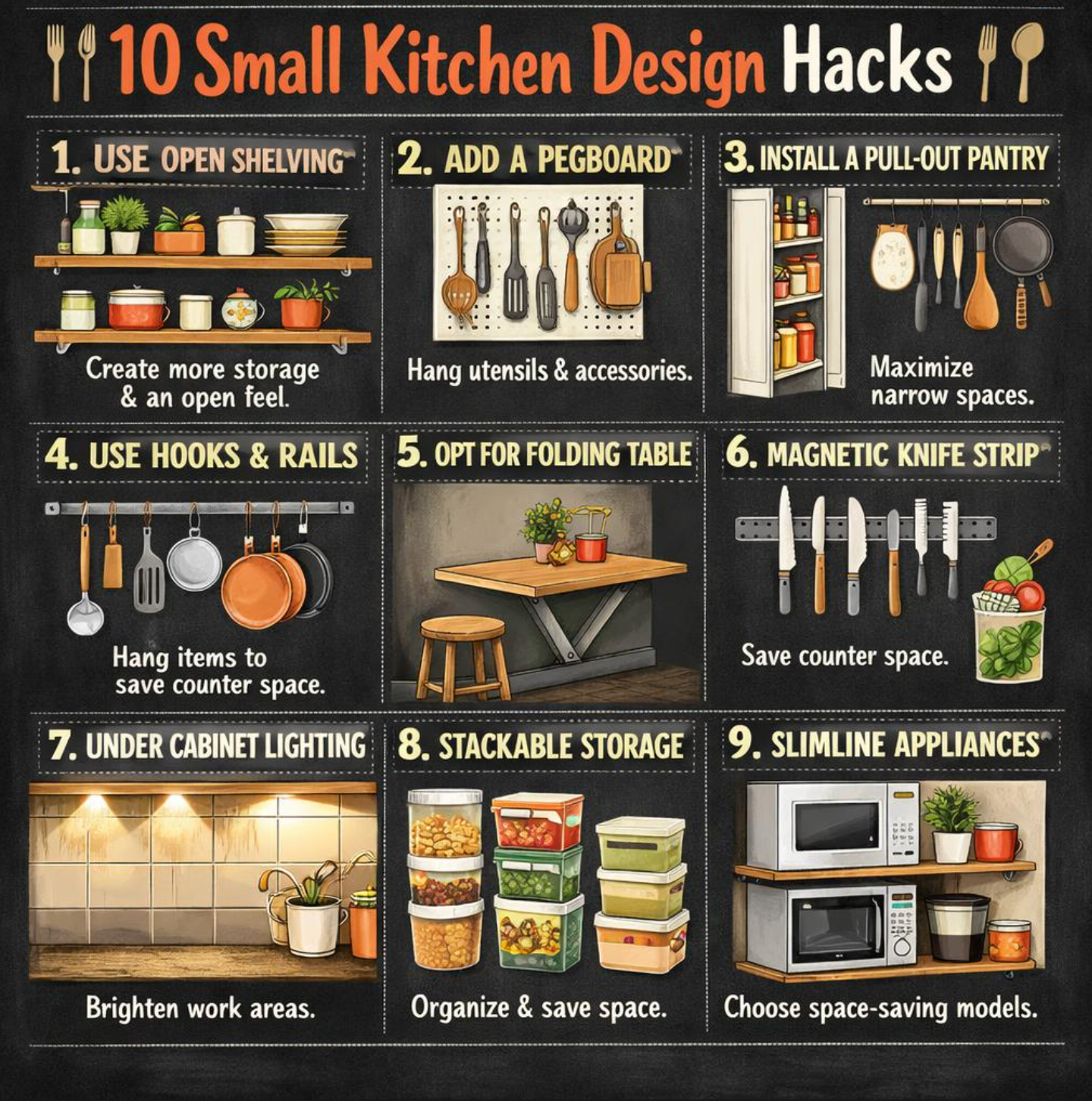
10 Small Kitchen Design Hacks You Need to Try (London Homes Edition)
Intro—Kitchen Design Hacks

If your London kitchen feels cramped, cluttered, or like you’re constantly playing “move this so I can use that,” you’re not alone. Most small kitchens don’t actually need more square footage — they need better layout decisions, smarter storage access, and lighting that makes the space feel bigger.
Below are my go-to “designer hacks” that genuinely move the needle in London flats, terraces, and period homes — plus costs, value tips, pros/cons, and an FAQ.
Additional Kitchen Design Hacks to Transform Your Space
The 20-minute designer audit (do this before spending money)
Implement these kitchen design hacks to maximise your space effectively. Each kitchen design hack is tailored to enhance functionality and style.

Before you buy anything, quickly check what’s controlling your layout:
Measure the space thieves
- Door swings (including dishwasher/oven doors)
- Window openings (and handles that hit wall units)
- Radiators, boiler positions, meter cupboards, bulkheads
- Chimney breasts (very common in Victorian/Edwardian homes)
Decide your upgrade level
- Refresh: lighting, storage upgrades, cosmetic changes
- Refit: new units/worktops/appliances (same layout)
- Replan: move layout/plumbing/electrics (biggest change)
Pick 3 non-negotiables
Dishwasher? Full-height fridge? Pantry? Seating? Laundry? A proper bin system?
Small kitchens punish “we’ll decide later.”
The 10 small kitchen hacks
Hack #1: Take cabinets to the ceiling (full-height storage)
This is one of the quickest ways to make a small kitchen feel tidier and more premium.
- More storage without eating floor space
- Cleaner lines (no dusty “dead zone” above wall units)
- Great for flats and narrow galleys
Client experience (typical London flat):
A couple in a Zone 2 flat swapped short wall units for full-height cabinetry and added bridging above the fridge. Their kitchen didn’t get bigger — but it stopped feeling “busy” because everything finally had a place. When they later sold, viewings feedback repeatedly mentioned “great storage for a flat.” (Not a guaranteed value uplift — but it improves buyer perception and removes objections.)
Hack #2: Replace shelves with drawers (and add internal drawers)

In small kitchens, drawers feel like cheating — because you can actually access everything.
Let’s dive deeper into these kitchen design hacks to uncover their benefits.
- Deep drawers for pans
- Shallow internal drawers for cutlery/spices
- No more rummaging at the back of a cupboard
Designer tip: If budget is tight, prioritise drawers in the main prep/cooking zone first.
Incorporating these kitchen design hacks can lead to a more efficient cooking experience.
Hack #3: Use a slim pull-out pantry (even 150–300mm helps)
These kitchen design hacks focus on utilising your vertical space effectively.
That narrow “filler gap” can become your best storage:
- Oils, spices, tins, sauces
- Baking trays (in a tall narrow slot)
- Cleaning supplies (if safely separated)
It’s one of the most satisfying upgrades in a galley kitchen because it adds function without changing layout.
Every one of these kitchen design hacks aims to bring practicality and elegance to your cooking space.
Hack #4: Make corner cabinets actually usable (proper corner solutions)

Corner cupboards are either genius… or dead space you avoid forever.
A proper corner mechanism (pull-out/swing-out/carousel-style) turns wasted space into usable storage. Corner solution ideas are widely recommended for maximising awkward corners. (George Cabinetry)
Client experience (terraced galley):
A terraced-house kitchen had a “black hole corner.” After installing a corner pull-out, the client moved everything bulky (mixers, big pots) off the worktop. Their words: “It finally feels like a kitchen, not a storage problem.”
Hack #5: Install a real bin system (the “clear worktops” hack)
Explore how these kitchen design hacks can optimise your workflow.


If your bins are freestanding, your kitchen will always feel smaller.
A pull-out bin drawer:
- frees floor space
- keeps mess hidden
- helps you keep worktops clear (which is the real “big kitchen” feeling)
Hack #6: Layer your lighting (small-kitchen cheat code)


Lighting is one of the highest-impact upgrades in tiny kitchens — and people usually underdo it.
The simple 3-layer plan
- Ceiling ambient (general brightness)
- Under-cabinet task lighting (worktops)
- Warm accent (makes it feel cosy in the evening)
Client experience (Victorian kitchen):
A small Victorian kitchen looked gloomy even with “nice units.” After adding under-cabinet lighting and warmer ambient lighting, it suddenly photographed better and felt bigger at night — which mattered when they later listed the home. (Again: not a guaranteed £ uplift, but it can improve presentation and buyer reaction.)
Hack #7: Calm your finishes (reduce visual clutter)

Too many colours, materials and tile patterns can chop a small room into pieces visually.
Keep it simple
- Fewer finishes = calmer look = bigger feel
- If you want drama: do one hero feature, not five
Houzz’s UK kitchen trends consistently show homeowners prioritising things like storage and splashback choices (e.g., tiled, quartz/slab-style), which can be adapted to a “less visual noise” approach in small spaces. (Houzz)
Hack #8: Right-size appliances to protect your prep zone

In small kitchens, your biggest luxury is clear prep space.
- Consider a 45cm dishwasher if space is tight
- Avoid a massive sink that steals your only prep area
- Think “multi-function” to reduce countertop gadgets
Hack #9: Add one “hero upgrade” to look premium on a budget
If you want that “designer kitchen” feel without a full rebuild:
- Upgrade the worktop or
- Go bold on the splashback or
- Upgrade handles/tap/lighting
One standout detail can lift the whole room — especially in small kitchens where everything is visible at once.
Hack #10: Design by zones (prep / cook / clean), not rigid rules
Small kitchens rarely fit the classic triangle perfectly. Instead:
- Put your prep zone near the sink
- Keep cooking tools near the hob
- Put plates/cups near the dishwasher
This makes everyday cooking feel smoother, even in a tight galley.
London costs and “what you’ll typically pay”
Prices vary a lot by specification and whether you’re moving plumbing/electrics. Also: many published guides are UK averages — London labour can run higher depending on access, parking, building rules, and complexity.
Quick cost table (planning ranges)
| Upgrade / Scope | Typical UK Range | Notes |
|---|---|---|
| Under-cabinet lighting | £150–£800+ | Depends on length + electrical access |
| Slim pull-out pantry | £200–£1,200+ | Hardware quality changes price fast |
| Corner cabinet mechanism | £150–£900+ | Many options; choose quality for durability |
| Drawer upgrades / internal drawers | £100–£600+ | Great usability ROI |
| Labour to fit a kitchen (labour only) | ~£1,000–£3,000 | UK guide range (MyJobQuote) |
| Typical “average fitting” figure | ~£3,500 | Common reference point (Checkatrade) |
| Trade rates (context) | fitter £150–£250/day; plumber £40–£60/hr; electrician £50–£70/hr | Helps estimate labour mix (MyBuilder) |
Full renovation budget reality check
Houzz’s UK kitchen trends study reports median spending rising, including a median spend of £17,500 for major and minor kitchen renovations in the UK (latest study referenced below). (Houzz)
Use that as a benchmark — your small kitchen might come in lower, but costs can climb quickly when services move or specs go premium.
Investing in these kitchen design hacks can significantly enhance your space.
Tips that can add value (without promising miracles)
A well-executed kitchen can help a home sell faster and feel “turnkey”, especially in London where buyers compare a lot of properties quickly.
What tends to add value and buyer appeal
- Storage that looks intentional (pantry, drawers, bin system)
- Great lighting (bright + warm, not harsh)
- Integrated / built-in feel (especially in flats)
- Cohesive finishes (so it reads “designed,” not pieced together)
“How much value does a new kitchen add?”
You’ll see a range of claims. Several UK industry sources commonly cite ~5–6% as a potential uplift for a new/updated kitchen, but this varies massively by area, finish level, and market conditions. (Appleton Kitchens)
Treat percentages as indicative, not guaranteed — the safer mindset is: a better kitchen reduces objections and increases desirability, which can improve sale outcomes.
Client experience (1930s semi):
A family re-planned a dated kitchen into a bright, well-zoned layout with pantry storage and better lighting. When they eventually sold, they didn’t say “we gained X% because of the kitchen,” but the estate agent feedback was consistent: buyers felt the home was “done” and were less likely to negotiate on renovation costs. That’s often the real-world value win.
Implement these kitchen design hacks to enhance the aesthetics of your home.
Pros and cons of upgrading a small kitchen
Pros
- Small changes can deliver big lifestyle improvement (flow + storage + light)
- A tidy, bright kitchen photographs better and shows better
- Many hacks are non-structural (less disruption than moving walls)
Cons
- Mistakes are magnified (door clashes, no prep space, tight walkways)
- Cheap storage hardware can feel bad fast (pay for quality where it matters)
- If you start moving plumbing/electrics, budgets can jump quickly
Incorporate these kitchen design hacks for a more organised space.
FAQ (London homeowner edition)
What’s the best layout for a small London kitchen?
Most often: galley or L-shape, planned around zones and clear clearances. One-wall layouts work well in studios when you go tall and keep the worktop clear.
What’s the fastest upgrade with the biggest impact?
Usually under-cabinet lighting + a bin system + drawer improvements.
Are corner solutions worth it?
If you currently avoid using your corner cupboard, yes — it can unlock valuable storage in tight kitchens. (George Cabinetry)
How much does a small kitchen renovation cost in London?
A lot depends on spec and whether you move services. For UK context, Houzz reports a median spend of £17,500 across major and minor kitchen renovations in its latest UK trends study. (Houzz)
London can run higher in labour and logistics, so plan contingency if access is tricky.
Apply these kitchen design hacks to create a seamless cooking experience.
Will a new kitchen definitely add value?
Not “definitely.” Many industry sources cite potential uplift figures (often ~5–6%), but value depends on your area, the quality of the work, and how dated the old kitchen was. (Appleton Kitchens)
These kitchen design hacks are not just trends; they’re essential for modern living. Consider these kitchen design hacks as part of your planning process. Embrace these kitchen design hacks for a stylish and functional kitchen. These kitchen design hacks are essential for maximising your kitchen’s potential.